Detailed Explanation of the Low-Altitude Substitute-Material Cultivation Method for Gastrodia elata
Gastrodia elata is a rare and precious traditional Chinese medicine. In the past it relied on wild sources, growing in mountain forests above 500 m in elevation, and was very scarce and difficult to dig up; it now faces extinction. The development of artificial cultivation of Gastrodia elata has saved this precious species, but technically it still cannot escape high-altitude cultivation, and the raw material cannot be separated from log wood (...
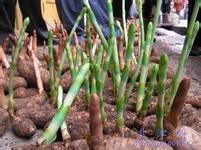
Gastrodia elata is a rare and precious traditional Chinese medicine. In the past it relied on wild sources, growing in mountain forests above 500 m in elevation, and was very scarce and difficult to dig up; it now faces extinction. The development of artificial cultivation of Gastrodia elata has saved this precious species, but technically it still cannot escape high-altitude cultivation, and the raw material cannot be separated from log wood (oak), which greatly limits the regions where Gastrodia elata can be cultivated. Second, it is restricted by the felling of forest resources. These two major drawbacks have long troubled the development of Gastrodia elata, and it has never been possible to achieve modernized, standardized cultivation of Gastrodia elata.
This method addresses the shortcomings of the existing techniques described above. Through long-term research and experimentation, we have worked out a new cultivation method for Gastrodia elata that is not limited by regional altitude or raw materials. In areas below 300 m in elevation, straw and corncobs can be used to cultivate Armillaria mellea and produce high-yield, high-quality Gastrodia elata. Through improvements in fine variety selection and breeding, cultivation environment, cultivation raw materials, culture medium formula, and cultivation methods, low-altitude substitute-material cultivation of Gastrodia elata has been achieved. The specific details are introduced as follows:
1. Raw material selection and treatment: To cultivate Gastrodia elata, Armillaria mellea must first be cultivated well. In the past, log wood (oak species) was mainly used to cultivate Armillaria mellea. With the protection of ecological balance, the state prohibits the felling of forests, so the raw materials for cultivating Armillaria mellea with log wood have been affected. In order to find a way out, we conducted experiments with straw, and after repeated exploration and practice it was proved that whole corncobs are the ideal material for cultivating Armillaria mellea.
The material used to cultivate Armillaria mellea with substitute materials has certain special requirements. Corncobs can be used either dry or fresh, but whole kernels that are free of mold and rot are best. If fresh corncobs cannot be used in time, they must certainly be placed under the sun to be fully dried before they can be stored. Otherwise, if there is moisture, they will become moldy during storage. In particular, green mold and yellow mold occur very easily and will affect the growth of Armillaria mellea in the future. If any moldy ones are found, they must certainly be picked out, or quicklime water can be sprayed on them, or they can be soaked to eliminate the mold. However, when using them, they must certainly be rinsed with clean water, so as to avoid excessively high alkalinity affecting the growth of Armillaria mellea.
2. Selection of Gastrodia elata seeds: The quality of Gastrodia elata seeds is very closely related to the yield of Gastrodia elata. There are two ways to obtain Gastrodia elata seeds: one is sexual reproduction; that is, after Gastrodia elata completes its physiological process, the pollen seeds from bolting, flowering, and seed setting, or pollen seeds after artificial cross-pollination. After the pollen seeds are cultivated with germination-promoting fungi and Armillaria mellea for 3-5 months, first-generation seeds the size of peanut kernels can be dug out, called "zero-generation seeds," also known as sexually reproduced hybrid seeds. This variety is conducive to high and stable yields of Gastrodia elata. In particular, after distant hybridization from wild black-stem and red-stem Gastrodia elata, the selected "TC828 variety" has become the current first choice for high-yield cultivation of Gastrodia elata.
The other is asexually propagated Gastrodia elata seeds, which are the small Gastrodia elata seeds that appear each time Gastrodia elata is dug up. These small Gastrodia elata are cultivated again, and after one year they become commercial Gastrodia elata. The continuous cyclic cultivation of small Gastrodia elata is called an asexually propagated variety. However, after 3-4 years of asexual reproduction, degeneration easily occurs. Whether degeneration is fast or slow is related to environmental conditions and techniques. In order to achieve high quality and high yield of Gastrodia elata, it is best to choose sexually hybridized Gastrodia elata seeds.
3. Selection of cultivation site: In the past, Gastrodia elata generally grew in mountain forests at an elevation of 500-1500 m, and areas at 800-1200 m were relatively suitable. Later, artificial cultivation also selected these high-altitude mountain forests. The main reason is that Gastrodia elata belongs to the medium- and low-temperature varieties and is afraid of high temperatures. In order to solve this problem, in addition to selecting and breeding Gastrodia elata seeds and domesticating varieties with higher temperature adaptability, the key is to take corresponding measures in the selection of the cultivation site and in artificial cooling, so that cultivation of Gastrodia elata in low-altitude areas can be fully realized.
Low altitude refers to plain areas below 300 m. Cultivation can be carried out in cool indoor spaces, outdoors under forest, or under artificial shade sheds. A place should be chosen that avoids both direct sun exposure and washing away by floods; preferably it should be shady, damp sloping land that drains well. As for the environment, it is best to have large areas of natural shade forest or artificial shade forest. The soil should preferably be fertile, fairly loose and airy, and not easily compacted. Sandy soil or humus soil can also be used. The soil moisture content should be between 50%-60%; the suitable soil moisture is when the soil can be squeezed into a ball by hand and breaks apart as soon as it is dropped. Clay or compacted soil is generally not suitable.
4. Cultivation of Armillaria mellea: There are many kinds of Armillaria mellea. Not all Armillaria mellea are suitable for the growth of Gastrodia elata, and not all those that can be suitable for the growth of Gastrodia elata are superior Armillaria mellea varieties. Armillaria mellea also differ in quality. Only high-quality Armillaria mellea can grow together with Gastrodia elata and complement each other nutritionally. At present, the superior Armillaria mellea variety "XB-9" has been selected from several Armillaria mellea varieties. It is most compatible with the superior Gastrodia elata variety "TC828" and is the foundation for high-yield low-altitude cultivation of Gastrodia elata.
Cultivating Armillaria mellea with corncobs has the advantages of abundant raw material sources, low cost, fast growth, and good results. The shortcoming is that it can only be used for one year and must be replaced every year, unlike log wood Armillaria mellea, which can be used for 2-3 years. The method for cultivating Armillaria mellea with corncobs is: first soak the corncobs in water for 12-24 hours (they must be soaked through), take them out and drain off the excess water. First spread a layer of corncobs on the ground, about 10 cm thick, sprinkle with Armillaria mellea stock spawn, using 750 g/bottle per sq m. Then spread a second layer of corncobs, sprinkle with Armillaria mellea spawn again, and then carry out a third or fourth layer in the same way, then cover with soil 10-15 cm to let it colonize. Another method is to fill the gaps between the corncobs with fine soil after each layer of corncobs is spread and sprinkled with Armillaria mellea spawn, then spread the second layer of corncobs, and after sprinkling with Armillaria mellea spawn, fill the gaps between the corncobs with fine soil; generally no more than four layers.
After cultivation at 18°C-22°C, in 2-3 months the Armillaria mellea rhizomorphs fill the entire corncob material, and then it can be used for Gastrodia elata cultivation. If there is not enough Armillaria mellea material, expanded cultivation of Armillaria mellea can also be carried out. This method is to add uncultivated corncobs to corncobs that have already been cultivated with Armillaria mellea, in a ratio of 50% each, with the same operation method as above, and finally cover with soil to let it colonize. This method is simple and easy to carry out and does not require stock spawn. As long as it is not affected by high temperature and pests and diseases in the environment, causing degeneration or variation of Armillaria mellea, this method can be used in long-term cyclic use.
5. Cultivation method of Gastrodia elata: Low-altitude cultivation of Gastrodia elata can be carried out indoors or outdoors, and the cultivation methods are basically the same. First spread a layer of loose soil 10 cm thick and 1 m wide on the ground, place the corncob spawn material on it, and spread it flat on the soil. Each layer of corncobs should be separated by 10-12 cm. Then place one small Gastrodia elata on each side of each corncob. The distance between small Gastrodia elata should preferably be 10 cm, and they should not be too sparse or too dense. After the Gastrodia elata are sown, immediately cover with soil 10 cm thick, then continue to sow the second layer in the same way, and finally cover with soil 15 cm thick, then compact the soil surface and the surroundings. Use 1 m width as one bed, leaving a walkway in the middle; the length is unlimited and can be determined according to the site. After planting, the height is generally between 30-35 cm. The surroundings of the bed can be retained with bricks or left exposed. In short, it must not be too wide: first, it is convenient for management; second, it is beneficial for ventilation for the growth of Gastrodia elata.
In addition to the above method of cultivating Armillaria mellea in advance for Gastrodia elata cultivation, corncobs plus Armillaria mellea spawn, or prepared corncob spawn material, can also be planted together with Gastrodia elata at the same time. However, the Gastrodia elata must be placed close to the spawn material. The new material serves as a bridge connecting the spawn material and is also a reserve force for the growth of Armillaria mellea and Gastrodia elata. This method can provide a guarantee for insufficient nutrient supply to Gastrodia elata in the later stage.
6. Management techniques: The management of low-altitude substitute-material cultivation of Gastrodia elata mainly involves temperature and humidity management. After Gastrodia elata is planted, the suitable temperature during the growth stage is between 15°C-25°C, and the most suitable is between 18°C-22°C. If it is higher than 28°C, growth stops, and above 30°C it dies. In particular, when the temperature during the dog days continues to reach above 30°C and is accompanied by high humidity, Gastrodia elata will rot, and when digging it up many rotten large Gastrodia elata will be found. Therefore, first, direct sun exposure must be avoided; second, measures should be taken as much as possible to lower the temperature, preferably controlling it between 18°C-22°C. Humidity is also very important for the growth of Gastrodia elata. Generally, the suitable soil moisture content is between 50%-60%. Too dry or too wet is not conducive to growth. Soil that is too wet affects ventilation for Gastrodia elata and makes it prone to rot, so it should be kept at the soil moisture level at the time of sowing. During management, if the surface soil is found to be dry and white, a small amount of water can be poured; it is enough to keep the surface soil somewhat moist. Do not pour too much water into the center of the soil.
Light management is not very important. Although Gastrodia elata is a plant, it cannot carry out photosynthesis. It can grow as long as conditions are not completely dark. However, strong direct sunlight or sun exposure causes excessively high temperatures, which is not conducive to growth. Therefore, artificial shade sheds or shady, cool environments under trees must be used.
Ventilation issue: The growth of Gastrodia elata requires a certain amount of air. Whether indoors or outdoors, under any conditions, plastic film must not be used for tightly covering. The areas for cultivation and colonization must not be joined into one large continuous piece; gaps or walkways must be left at 1 m width to facilitate ventilation.
7. Harvesting and processing techniques: Gastrodia elata is cultivated once a year, and the growth cycle is one year. The harvest period of Gastrodia elata is also the sowing period. In the Sichuan region, harvesting is generally carried out in November-December each year. At harvest, large Gastrodia elata are selected as commercial tubers for processing, and small Gastrodia elata can be used as seeds for cultivation.
The harvesting method for Gastrodia elata is: dig away the surface soil, take out the Gastrodia elata, and classify them by size. Generally they can be divided into two major categories: commercial tubers and seed tubers. Commercial tubers are further divided by large, medium, and small into upper, middle, and lower grades, and seed tubers are further divided by size into white-headed tubers and rice tubers.
When digging Gastrodia elata, generally harvesting, sowing, and processing should proceed together. Timely sowing is beneficial to the survival rate and yield of Gastrodia elata the following year, and immediate processing is beneficial to improving the quality and color of Gastrodia elata.
There are many processing methods for Gastrodia elata. A simple and easy method is introduced here: immediately wash the surface soil and rhizomorphs off the freshly dug Gastrodia elata with water, then promptly steam them in a steamer or boil them in water. The steaming or boiling time is generally about 30 minutes, and it is suitable when the center of the Gastrodia elata is cooked through. They must not be overcooked or undercooked. After steaming or boiling, dry them immediately by baking or sun-drying. During the baking and sun-drying process, when the Gastrodia elata are half dry and half wet, in order to prevent mold, insects, and to increase whiteness, they can be fumigated with sulfur, and then baked or sun-dried again until completely dry, then stored moisture-proof.