Causes of Gastrodia elata Trait Degradation and Control Methods
Degradation of Gastrodia elata traits often manifests as decreased yield of arrow gastrodia, with individuals becoming smaller and slender; a substantial reduction in the yield of rice gastrodia and white gastrodia, which turn ginger-yellow or light brown, with poor stress resistance, and the original yield and traits cannot be fully expressed. The causes are generally as follows: 1. Multiple generations of asexual reproduction. Generally after 5 to 6 generations of asexual reproduction...
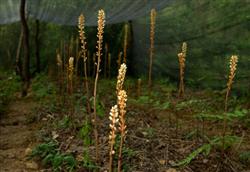
Degradation of Gastrodia elata traits often manifests as decreased yield of arrow gastrodia, with individuals becoming smaller and slender; a substantial reduction in the yield of rice gastrodia and white gastrodia, which turn ginger-yellow or light brown, with poor stress resistance, and the original yield and traits cannot be fully expressed. The causes are generally as follows:
1. Multiple generations of asexual reproduction. Generally, degradation begins to appear after 5 to 6 generations of asexual reproduction, but when cultivated on different soil types, the speed of degradation varies. Degradation is slower when cultivated in granite soil, followed by yellow-brown loam sandy soil parent material, and acidic soil formed by weathering of shale or limestone.
2. Continuous cropping. Under normal circumstances, the yield is high in the first year and low in the second year, and after 3 to 4 years, the yield declines rapidly.
3. Degradation of Armillaria mellea. It first manifests as reduced adaptability and stress resistance, with slow growth of rhizomorphs; subsequently the rhizomorphs become inelastic, fragile, and even turn into empty shells. As the number of subculturing generations continues to increase, Armillaria mellea forms thick, long, numerous and branched dark brown rhizomorph networks on the fungal wood.
4. Dense deep-layer cultivation. This method leads to a lack of oxygen during the growth of Gastrodia elata, resulting in decreased vitality.
5. Diseases. Old seed gastrodia, old fungal wood, and old pits are most susceptible to disease; in mild cases growth is poor, and in severe cases there is total crop failure.
6. High temperature. It induces and accelerates disease onset, causing poor growth of Gastrodia elata. The most obvious sign is that the head of arrow gastrodia takes on a "bottleneck" shape, with an increase in rice gastrodia and small white gastrodia, and an increase in rotten gastrodia.
Control methods:
① Use wild species and introduce species from other locations, especially introducing from higher terrain to lower terrain. ② Screen and cultivate high-quality Armillaria mellea strains, purify and expand them, compare sub-strains, rejuvenate and propagate, cultivate high-quality fungal wood, and use high-quality loose culture material as filler and cover material. ③ Change the cultivation site, select acidic sandy loam, and avoid continuous cropping. ④ Adopt sexual reproduction techniques. Alternate sexual reproduction with asexual reproduction; corms from sexual reproduction are only planted for 4 to 5 generations. ⑤ Apply hybrid species. ⑥ Strictly prevent and control diseases.