Control methods for leafminer flies in yardlong bean cultivation
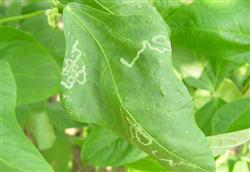
How to control leafminer flies when growing yardlong bean? Here are the methods. Liriomyza sativae belongs to the genus Liriomyza, family Agromyzidae, order Diptera. The pest mainly damages plants as larvae, which bore between the upper and lower epidermis of the leaves and feed on the leaf sap and mesophyll, forming nearly round, punctate, sunken yellow spots on the leaves. After the larvae mine and feed on the mesophyll, they form tunnels. The tunnels are curved...
How to control leafminer flies when growing yardlong bean? Here are the methods
Liriomyza sativae belongs to the genus Liriomyza, family Agromyzidae, order Diptera. The pest mainly damages plants as larvae, which bore between the upper and lower epidermis of the leaves and feed on the leaf sap and mesophyll, forming nearly round, punctate, sunken yellow spots on the leaves. After the larvae mine and feed on the mesophyll, they form tunnels. The tunnels are winding and tortuous, with no fixed direction, forming patterned grayish-white streaks. They damage vegetables such as yardlong bean, eggplant, and loofah, seriously affecting the normal growth and development of the vegetables. In the peak season for leafminer flies, early detection and early control are necessary to reduce the damage and avoid unnecessary economic losses for vegetable growers. Control methods: 1. Agricultural control. After harvesting the previous crop, plow deeply in time to reduce the pest population and lessen the damage. Taking advantage of the phototaxis of leafminer flies, black light traps can be used to kill adults. Mix machine oil and butter and apply it to yellow boards, then insert them in the field to stick the flying adults. Insert 20-30 yellow boards per mu. 2. Chemical control. Because leafminer fly larvae mine leaves and cause damage, it is necessary to do a good job of forecasting and monitoring the pest situation, and to seize the key period from the peak egg-laying stage to the early hatching stage for early control. The following can be used: 48% Lorsban emulsifiable concentrate at 1000 times dilution, 20% Qianyingbao emulsifiable concentrate at 3000 times dilution, 2.5% Kung Fu emulsifiable concentrate at 2000-3000 times dilution, 1.8% abamectin emulsifiable concentrate at 3000 times dilution, 75% Qianke at 5000 times dilution, 5% Regent suspension concentrate at 1000 times dilution. In view of the characteristics of the larvae feeding on sap and mesophyll, 500 times dilution of resistance-reducing liquid (Hailiping, Xiaochongwang) can be added to the spray solution, and an appropriate amount of white liquor can also be added to improve efficacy. To prevent the development of pesticide resistance, the above pesticides should be used alternately.
Click to get more yardlong bean cultivation techniques
Click to get more vegetable cultivation techniques