How can you grow autumn long beans for a high yield?
How can you grow long beans for a high yield in autumn? Please explain the cultivation method. For growing long beans in autumn, you can refer to the following method: 1. Variety and soil selection. For autumn long bean cultivation, choose varieties with strong cold and moisture resistance and a strong ability to reflower. For the soil, choose a sandy loam with a relatively high position, deep soil layer, good drainage, ...
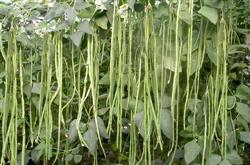
How can you grow long beans for a high yield in autumn? Please explain the cultivation method
For growing long beans in autumn, you can refer to the following method:
1. Variety and soil selection.
For autumn long bean cultivation, choose varieties with strong cold and moisture resistance and a strong ability to reflower. For the soil, choose a sandy loam with a relatively high position, deep soil layer, good drainage, moderate pH and no previous cultivation of leguminous crops. 2. Sow at the right time and plant at a reasonable density.
Autumn long beans should be sown from August to September. Direct sowing is preferred. Plant at a reasonable density: use 1.25-1.5 kg of seed per mu, with row spacing of 50-60 cm and plant spacing of 8-10 cm, in double rows, sowing 2 seeds per hole.
3. Field management.
1. Insert bamboo and train the vines: generally, insert bamboo and train the vines when the seedlings grow to 30-40 cm. Vine training should be done in cool weather on a sunny day, preferably with about 4 vines trained per bamboo stake.
2. Fertilizer and water management: long bean fertilization should be based mainly on base fertilizer, with topdressing as a supplement. For the base fertilizer, when forming the beds, apply 1500-2000 kg of high-quality farmyard manure and 20 kg of compound fertilizer; at the early flowering stage, when earthing up, apply 30-40 kg of Xingwang fruit and vegetable compound fertilizer on both sides of the bed. Topdressing at the seedling stage should be light and diluted, gradually increasing the fertilizer concentration as the plants grow, and each topdressing should be done on a sunny day. During the harvest period, apply additional topdressing as appropriate according to the growth condition.
Long beans dislike moisture throughout the entire growth period. Soil that is too wet can easily cause excessive vegetative growth or root rot. This is especially true if the soil is too wet after sowing, as the seeds absorb too much water and sprout too early and too quickly, making the seedling tissues tender and weakening stress resistance, which can easily cause excessive vegetative growth or seedling death. Therefore, sowing should be done on a sunny day, and before sowing, first pour water thoroughly between the sowing rows and then sow; do not water within 2-3 days after sowing. When the seeds begin to emerge, water moderately, which helps the seedlings grow strong. During flowering and pod setting, the water requirement is greater, especially in autumn when the temperature is high and evaporation is large, so water in the early morning and evening to regulate the field microclimate.
4. Pest and disease control.
The main diseases of long beans are root rot and rust. For root rot, follow the principle of "prevention first, combining prevention and control" through crop rotation and field management. At the same time, when sowing, mix 1 kg of 50% carbendazim with 400-500 kg of fine soil and cover the seeds with it. In the early stage of the disease, drench the roots with a 200-300 times dilution of 37% root rot remedy or a 1000-1500 times dilution of dexon, once every 3-5 days, for 2-3 consecutive times. For rust, spray with a 200-250 times dilution of colloidal sulfur, or use 150-200 g of 15% triadimefon wettable powder mixed with 75-80 kg of water. The main insect pests are the bean pod borer and the cowpea pod borer. You can use a 500 times dilution of 25% dimehypo aqueous solution or 50-75 g of cascade mixed with 60 kg of water, spraying once every 7-10 days from budding to the early flowering stage, for 2-3 consecutive times.
Click to get more long bean cultivation techniques
Click to get more vegetable cultivation techniques