Symptoms and control methods of southern blight in mint
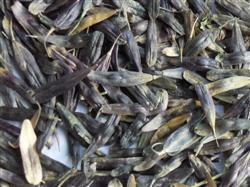
Isatis root seeds have a lifespan of 2 years. After more than 2 years, the seeds do not germinate; even if a small portion germinates, they soon die, which is called "failure to establish seedlings." Therefore, new seeds should be purchased whenever possible. Generally, newly produced Isatis root seeds (also called daqingzi) are blue-black in appearance, have good gloss and are shiny, with a relatively strong fresh fragrance,...
 Latin scientific name: Sclerotium rolfsii Sacc.
Damaged crop: mint
Damage symptoms: In the early stage of the disease, the aboveground leaves of the diseased plants fade, and a large amount of white mycelium and small brown rapeseed-like sclerotia grow at the stem base and ground level. After the disease spreads, the plants' growth vigor weakens, they wilt, or the whole plant dies.
Morphological characteristics of the pathogen: On PDA medium, the mycelium is white, lush yellow, and spreads radially; the hyphae are 2-8 micrometers thick, branch not at right angles, and have septa; the sclerotia are initially milky white, later becoming light yellow to tea brown or brown, spherical to oval, 1-2 mm in size, with a smooth and glossy surface. The surface layer of the sclerotium is composed of 3 layers of cells; the outer layer is brown, below the epidermal layer is pseudoparenchyma, and the middle is loose hyphal tissue.
Taxonomic attributes: called Athelia rolfsii, called Sclerotium rolfsii, belonging to the Deuteromycotina fungi
Distribution area: Jiangsu, Anhui, Guangdong, Sichuan, Yunnan and other provinces
Disease characteristics: The pathogen overwinters in the soil with diseased residues as mycelium or mycelial strands. When conditions are suitable the following year, the sclerotia or mycelial strands produce mycelium for primary infection. The silky mycelium produced by diseased plants extends to contact neighboring plants, or the sclerotia spread through water flow for secondary infection, causing the disease to spread and expand. The disease is severe in continuous cropping, heavy clay soil, low-lying terrain, or years or seasons with high temperature and high humidity.
Control methods: Avoid continuous cropping in heavily diseased fields. Advocate the application of Japanese enzyme bacteria compost or fully decomposed organic fertilizer. Inspect in time, and promptly pull out and burn diseased plants when found. Drench the diseased holes and neighboring plants with 5% Jinggangmycin aqueous solution at 1000-1600 times dilution, 50% Tianan aqueous solution at 500-600 times dilution, 20% tolclofos-methyl emulsifiable concentrate at 1000 times dilution, or 90% fenaminosulf wettable powder at 500 times dilution, drenching 0.4-0.5 L per plant. Or mix 40% mianzhongling with fine sand to make a 1:200 medicinal soil and mix it into the diseased soil, 100-150 grams per hole, once every 10-15 days. Use 0.4-0.45 kg of cultured Trichoderma harzianum, add 30 kg of fine soil, mix evenly, and scatter it over the base of the diseased plants. Stop applying the pesticide 5 days before harvest.
Commonly used pesticides: 5% Jinggangmycin aqueous solution, 50% Tianan aqueous solution, 20% tolclofos-methyl emulsifiable concentrate, 90% fenaminosulf wettable powder, 40% mianzhongling.