How to manage mint before and after emergence? Key technical points explained in detail
Based on many years of large-scale mint cultivation practice, effectively strengthening field management before and after the emergence of first-cut mint is an effective measure to achieve high yield, high quality and high efficiency. It can increase mint crude oil by l-1.5 kg per mu, with a net profit increase of about 100 yuan. 1. Clear ditches and improve soil moisture conditions to reduce field humidity. Mint is both afraid of drought and intolerant of waterlogging, and soil...
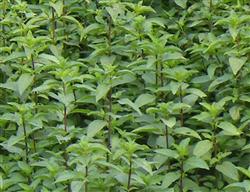
Based on many years of large-scale mint cultivation practice, effectively strengthening field management before and after the emergence of first-cut mint is an effective measure to achieve high yield, high quality and high efficiency. It can increase mint crude oil by l-1.5 kg per mu, with a net profit increase of about 100 yuan.
1. Clear ditches and improve soil moisture conditions to reduce field humidity. Mint is both afraid of drought and intolerant of waterlogging. The soil water-holding capacity is best at 75-80%; below 55% or above 95%, emergence and growth will be inhibited. If soil moisture remains saturated or supersaturated for a long time, not only will emergence fail, but the root system may even suffocate and die. Therefore, doing a good job of clearing ditches and improving soil moisture conditions, achieving a complete ditch system, and ensuring both irrigation and drainage play an important role in guaranteeing drought-resistant seedlings, full seedlings, uniform seedlings, strong seedlings and reducing the occurrence of diseases.
2. Remove impurities and maintain purity to improve crude oil quality. After mint emerges, 2-3 rounds of impurity removal should be carried out; this is a necessary measure to improve crude oil quality. According to the characteristics of the original variety and the odor of the leaves, mixed mint plants should be pulled out with roots and taken out of the field. Impurity removal should be done early rather than late, so that the field purity of mint is above 99%, ensuring the purity of crude oil is above 98%. In this way, each kg of crude oil can increase in value by 15-20 yuan.
3. Thin where dense and fill where sparse, and maintain reasonable planting density. Because first-cut mint sowing is affected by factors such as seed roots, sowing quality and soil moisture, emergence is often uneven. Therefore, after emergence and before budding, thinning where dense and filling where sparse should be carried out. For transplanted mint, promptly water with a 1.5% urea solution to promote survival. A reasonable basic seedling population is the key to high-quality and high-yield mint. If the basic seedling population is insufficient, the fresh grass amount is low and the yield is not high; if the basic seedling population is too large, although the fresh grass amount is high, there are many stems and few leaves, and leaves are the main storage organ for crude oil, so high yield is also difficult to achieve. According to many years of production practice, for a-53 and Hu 39, the suitable basic seedling population per mu is 30,000-40,000 in pure cropping fields and 50,000 in intercropping fields.
4. Chemical weed control to prevent weed damage. The associated weeds of first-cut mint in early-cropping rotation or continuous cropping fields are grasses and broadleaf weeds, while in paddy-upland rotation fields they are mainly sedges. In fields dominated by grasses, use 50 ml of 5% quizalofop-p-ethyl emulsifiable concentrate per mu mixed with 30 kg of water, and spray on stems and leaves at the 2-4 leaf stage of grasses; in fields where grasses and broadleaf weeds are mixed, before mint emerges in spring, use 250 g of 25% diuron wettable powder per mu, mixed with 40 kg of water and sprayed, which can effectively prevent weed damage.
5. Timely disease and insect control. During the seedling stage of first-cut mint, the main diseases are black stem disease, sclerotinia disease and viral disease. These diseases are mainly prevented through agricultural control measures such as clearing ditches and improving soil moisture conditions to reduce field humidity; appropriately reducing nitrogen fertilizer use and increasing phosphorus and potassium fertilizer use, and applying organic fertilizer; and reasonable planting density to improve ventilation and light transmission conditions. The main pests during the seedling stage of first-cut mint are snails and cutworms. Use 250 g of 90% crystalline trichlorfon per mu, dissolve it in an appropriate amount of water, spray it onto 20 kg of roasted soybean cake or cottonseed cake, mix well into poison bait, and evenly scatter it in the field in the evening. The control effect is above 90%. In fields where aphids reach the threshold, use 16-20 ml of 2.5% deltamethrin emulsifiable concentrate per mu, mix with 30 kg of water and spray evenly. The control effect reaches 96%.
6. Reasonable fertilization to promote strong but not excessive seedling growth. During the seedling stage of first-cut mint, too much nitrogen fertilizer should not be applied; otherwise, growth will be excessive, stems will be weak, and lodging will be caused in the middle and late stages. Also, most basal leaves of mint fall off in the middle and late stages and become ineffective leaves. This phenomenon is especially prominent when the basic seedling population is relatively high and fertilizer is lacking in the middle and late stages, so seedling fertilizer should be controlled. For soil with good fertility, sufficient base fertilizer and normal leaf color after emergence, generally no fertilizer is applied. For poor soil, insufficient base fertilizer, basic seedling population per mu below 20,000, and obviously yellowing leaf color, apply 5-8 kg of urea per mu to promote the seedlings from weak to strong.