When is the best time to fertilize rice?
When is the best time to fertilize rice? Please explain. Because the natural conditions, farming systems, production levels and fertilization levels vary greatly across the rice-growing regions of southern China, different fertilization methods also exist. The front-stable, mid-boost, late-supplement fertilization method: this method involves applying a certain amount of fertilizer in the early stage as a base, increasing the amount of topdressing in the mid stage to promote large panicles, and applying grain fertilizer in the late stage depending on the crop's condition. Generally, the base fertilizer accounts for 40%-60%; among the mid-stage topdressings, tillering fertilizer accounts for 30%, panicle fertilizer accounts for 50%, and grain fertilizer accounts for 20%. This method is mainly used for large-panicle, large-grain varieties of single-season hybrid mid-season and late rice with a longer growth period, and for fields with poor soil fertilizer retention capacity and insufficient fertilizer.
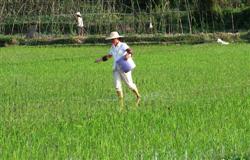
When is the best time to fertilize rice? Please explain.
Because the natural conditions, farming systems, production levels and fertilization levels vary greatly across the rice-growing regions of southern China, different fertilization methods also exist.
The front-stable, mid-boost, late-supplement fertilization method: this method involves applying a certain amount of fertilizer in the early stage as a base, increasing the amount of topdressing in the mid stage to promote large panicles, and applying grain fertilizer in the late stage depending on the crop's condition. Generally, the base fertilizer accounts for 40%-60%; among the mid-stage topdressings, tillering fertilizer accounts for 30%, panicle fertilizer accounts for 50%, and grain fertilizer accounts for 20%. This method is mainly used for large-panicle, large-grain varieties of single-season hybrid mid-season and late rice with a longer growth period, and for fields with poor soil fertilizer retention capacity and insufficient fertilizer.
The sparse, controlled, heavy fertilization method: this method is also mainly used for large-panicle hybrid rice. "Sparse" mainly refers to using a 1 chi x 3 x 4 wide-narrow row spacing under the condition of sparse sowing to raise strong seedlings with tillers. "Controlled" means controlling the base fertilizer (40%-50%), not applying tillering fertilizer, and draining the field once enough seedlings have emerged to control ineffective tillering. "Heavy" means heavily applying panicle fertilizer, with the panicle fertilizer accounting for 40%-60% of the total application, applied in two splits. The first application is the flower-promoting fertilizer applied 30-35 days before heading to increase the number of spikelets per panicle and the number of late tillers that form panicles; the second is the flower-preserving fertilizer applied at the booting stage (meiosis stage) to reduce spikelet degeneration and improve the seed-setting rate. At the heading stage, potassium dihydrogen phosphate is sprayed on the leaves 1-2 times as a grain-filling fertilizer.
No matter which fertilization method is used, it must be adapted to local conditions, with attention to both the crop and the soil, and fertilization must be scientific and reasonable. Generally, for a yield of 550-650 kg per mu, only 8-12 kg of pure nitrogen is needed; applying more is simply wasteful.
Click to get more rice cultivation techniques
Click to get more food crop cultivation techniques