What are the pollution-free control methods for rice stem borers?
How are rice stem borers controlled in a pollution-free way? Please explain the control methods. Stem borers are the common name for the rice striped stem borer and the rice yellow stem borer. The rice striped stem borer is distributed throughout the country. Besides damaging rice, the rice striped stem borer also damages wild rice stem, corn, sugarcane, reeds and other grass weeds. After overwintering, some larvae can invade broad...
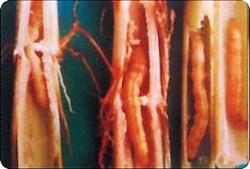
How are rice stem borers controlled in a pollution-free way? Please explain the control methods
Stem borers are the common name for the rice striped stem borer and the rice yellow stem borer. The rice striped stem borer is distributed throughout the country.
Besides damaging rice, the rice striped stem borer also damages wild rice stem, corn, sugarcane, reeds and other grass weeds. After overwintering, some larvae can invade broad bean, rapeseed, wheat and so on. It generally damages rice at the tillering stage, causing dead leaf sheaths and dead heart seedlings; at the booting stage and heading stage, causing dead booting ears and white ears; at the grain-filling stage and milk-ripe stage, causing half-blighted ears and insect-damaged plants. In Hunan, the rice striped stem borer generally has 3 generations per year, but in recent years southern Hunan has had incomplete or complete 4 generations. It overwinters as larvae in rice roots, rice straw, wild rice stem and other places. Generally, the first generation of moths peaks from May to June, the second generation of moths peaks in July, and the third generation of moths peaks from August to September.
The rice yellow stem borer is one of the main pests of rice in Hunan Province. The rice yellow stem borer has a single host and only damages rice. It generally damages rice at the seedling stage, causing dead heart seedlings; at the booting stage, causing dead booting ears; at the heading stage, causing white ears. It generally has a complete 4 generations. It overwinters as larvae in rice roots. The overwintering larvae begin to pupate in April, and the peak moth emergence periods are: the first generation in May, the second generation from late June to early-to-mid July, the third generation in August, and the fourth generation in mid-to-late September. The moths are phototactic and prefer to lay eggs in rice fields with heavy fertilizer and tender green growth. Generally, after the temperature drops in October, the larvae gradually move to the base of the rice stems to overwinter.
The following techniques can be used to control stem borers. First, agricultural control. Pull up white ears. From late September to early October, the third and fourth generation rice yellow stem borer larvae that cause white ears are generally larvae preparing to overwinter; at this time the white ears are obvious and easy to find, and the larvae are still resting on the upper part of the rice plants. Pulling up or cutting off the white ear plants at the root can eliminate part of the insect source. Cut rice at the mud level. When harvesting late rice, cutting at the mud level can reduce the insect source and destroy the overwintering sites of stem borers. Straw treatment. Many stem borers remain in the straw; if it is left in the rice field or on the field ridges, it can serve as an effective insect source the following year. Therefore, after harvesting late rice, the straw should be removed promptly or burned. In areas where wild rice stem is grown, the leftover wild rice stem plants should be cut at the mud level in winter and treated centrally. Early rice straw should be picked up immediately after cutting and must not be left on the field ridges for a long time, so as to reduce the insect source of the second generation of the rice striped stem borer; straw from early rice with a white ear rate of more than 1% caused by the rice striped stem borer must not be returned to the field, so as to prevent the remaining insects from directly damaging the late rice. Irrigate to kill pupae. During the pupal stage of the overwintering generation of stem borers (generally in mid-to-late April), irrigate to submerge the rice roots, which can drown most larvae and pupae; at the early pupation stage of the first generation of the rice striped stem borer (when individual larvae are found to have pupated), irrigate with shallow water to raise the pupation site, and then at the pupation peak (when half the larvae are found to have pupated), irrigate with deep water for 3 to 4 days, which can drown most mature larvae and pupae and reduce the occurrence of the second generation. Second, physical control. Use frequency-vibration insect-killing lamps to attract moths. Starting in late April, install 1 frequency-vibration insect-killing lamp about every 150 m in the rice field. During the moth emergence period of each generation of stem borers, turn on the lamp at 7 p.m. every night and turn it off at 7 a.m., which can effectively kill the moths. Third, chemical control. The control of stem borers should follow the principles of "accurate, heavy, and economical." Accurate means applying the pesticide at the right time according to the pest and disease information from the local plant protection department, and not applying it too early or too late. Generally, the pesticide is applied at the peak of young larvae. Heavy means focusing on the key points and applying the pesticide carefully with guaranteed quality and quantity. For the rice striped stem borer, the first generation should be controlled heavily; for the rice yellow stem borer, the second generation should be controlled heavily. Economical means reducing the amount of pesticide used as much as possible while ensuring the control effect, thereby lowering costs and reducing environmental pollution. At present, to control stem borers, 30 to 40 ml of 5% fipronil suspension concentrate, 120 to 150 ml of 20% triazophos emulsifiable concentrate, or 100 to 120 ml of 15% Hebang microemulsion can be used per mu, diluted with 45 kg of water for spraying. When using chemical control, a water layer 3 to 5 cm deep should be maintained in the field and allowed to dry naturally.
Click to get more rice cultivation techniques
Click to get more food crop cultivation techniques