The key to high-yield Atractylodes macrocephala lies in preserving seedlings in the early stage
As a traditional Chinese medicinal herb with relatively high economic value, Atractylodes macrocephala is being planted by more and more people. However, due to uneven levels of planting and management, the economic returns of growers vary greatly. This is especially true for beginners, who are not sure about the growth habits of Atractylodes macrocephala and the prevention and control of pests and diseases, often causing a large number of seedling deaths in the early stage, while...
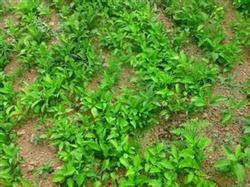
As a traditional Chinese medicinal herb with relatively high economic value, Atractylodes macrocephala is being planted by more and more people. However, due to uneven levels of planting and management, the economic returns of growers vary greatly. This is especially true for beginners, who are not sure about the growth habits of Atractylodes macrocephala and the prevention and control of pests and diseases, often causing a large number of seedling deaths in the early stage, low benefits, and in some cases even total loss. Through several years of planting, my greatest realization is: to achieve high yield of Atractylodes macrocephala, preserving seedlings in the early stage is most important.
I. Promote strong seedlings. Doing everything possible to promote uniform and strong Atractylodes macrocephala seedlings can greatly improve the disease resistance of Atractylodes macrocephala. Promoting strong seedlings is the foundation of high yield in Atractylodes macrocephala. The specific methods are as follows. First, carry out reasonable intertillage. After the Atractylodes macrocephala seedlings have all emerged, intertillage must be carried out twice. During intertillage, the principle of "deep first hoeing, shallow second hoeing" should be followed to reduce field humidity, increase soil permeability, and promote downward root growth. Second, spray foliar fertilizer. If the Atractylodes macrocephala seedlings are thin and weak, 15 kg of water can be mixed with 15 ml of Bi'ou plus 25 g of monopotassium phosphate and sprayed over the whole field. If the seedling leaves are small and yellowing, 15 kg of water can be mixed with 10 g of Ruipeile plus 5 g of Ruipeixin and sprayed over the whole field.
II. Control water and fertilizer. Because Atractylodes macrocephala is tolerant of drought and afraid of waterlogging, watering should be controlled as much as possible, especially at the seedling stage. Do not water unless absolutely necessary, but when watering, apply 200 ml of Ruimiaoqing plus 1.5 kg of Wuguying per mu as a drench to prevent seedling-stage diseases.
III. Prevention and control of pests and diseases. There are three major diseases that cause seedling death at the seedling stage of Atractylodes macrocephala: damping-off, root rot, and seedling blight. Among them, damping-off occurs most severely and causes the greatest damage. Damping-off is also known as "rotten stem blight," and occurs more severely on rainy days. The base of the stem of affected seedlings becomes dark brown, then shrinks and becomes sunken, causing the seedlings to bend over and die. Root rot occurs at the roots. The main root rots, causing seedling death. Seedling blight and damping-off occur at the same site, both at the base of the stem. After onset, the plants quickly lodge, but the upper part remains normal. In prevention and control, watering must first be controlled. The lower the field humidity, the milder the disease.
At the early stage of disease onset, for damping-off and root rot, use 15 kg of water mixed with 8 ml of Ruimiaoqing plus 20 g of Yiwei microbial agent for spray control. For seedling blight, use 15 kg of water mixed with 20 ml of Pulike for spray control. It should be noted that when spraying, the liquid should be allowed to flow to the rhizome area of the Atractylodes macrocephala seedlings.
The main insect pests of Atractylodes macrocephala include aphids, leaf miners, and cutworms. For aphids and planthoppers, use Jinhaonian for control. For leaf miners, use abamectin plus decis for control. To control cutworms, spray Baisude around the roots of Atractylodes macrocephala seedlings before evening.