Detailed Explanation of Licorice Seedling Raising and Transplanting Methods and Technical Key Points
The glycyrrhizic acid contained in licorice is 200 to 300 times sweeter than sucrose, making it the best natural sweetener discovered to date. China exports large quantities of licorice and its extracts to European, American and Southeast Asian countries, and it has become a major foreign-exchange-earning medicinal herb. Due to increasing demand at home and abroad, wild licorice resources are becoming increasingly depleted. Therefore, it is necessary to...
The glycyrrhizic acid contained in licorice is 200 to 300 times sweeter than sucrose, making it the best natural sweetener discovered to date. China exports large quantities of licorice and its extracts to European, American and Southeast Asian countries, and it has become a major foreign-exchange-earning medicinal herb. Due to increasing demand at home and abroad, wild licorice resources are becoming increasingly depleted. Therefore, artificial cultivation of licorice must be carried out.
Licorice is mainly distributed in China's "Three North" regions. It is not demanding regarding soil and prefers to grow in weakly alkaline sandy land, grassland, sand dunes, riverbanks, and desert and semi-desert environments. When introduced to the black soil of grain-producing regions, it can also achieve high yield and good quality.
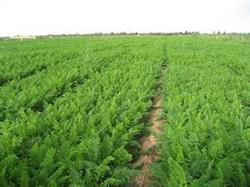
For artificial cultivation of licorice, it is best to raise seedlings and then transplant them, that is, first raise seedlings in a nursery for 1 year, then transplant the seedlings into the field in that autumn or the following spring. Raising seedlings on one mu can provide enough for transplanting 5 mu to 7 mu, and compared with direct sowing in the field, it gives a higher rate of finished product grades and requires less harvesting labor. For licorice, it is best to choose land that is fertile, loose in texture, well drained and rich in organic matter. For land preparation, deep plow 40 cm, and at the same time apply 3 m3 of high-quality farmyard manure and 20 kg of diammonium phosphate per mu as base fertilizer. Then form ridges 65 cm wide and press them, waiting for sowing. Sowing and seedling raising can be done in spring, summer and autumn. Autumn sowing is carried out before the ground freezes. On the ridge surface, use a plow to open a 20 cm wide furrow, level it after plowing, tread the grid by hand, and use a seed drop gourd to sow seeds soaked in fungicide evenly on the ridge surface, cover with about 2 cm of soil, and then press immediately. Sow 5 kg to 8 kg per mu. If soil moisture is good, full seedlings can emerge in about 10 days. To prevent weed damage, trifluralin herbicide can be sprayed on the ridge surface before sowing. It is advisable to use 1/5 of the reduced dosage stated in the instructions per mu, and sowing should be done 6 days after spraying.
After licorice seedlings emerge, frequently inspect the field to see whether there is any seedling death. If so, use 100 g of thiophanate-methyl powder plus 250 g of urea and 50 kg of water per mu, dissolve thoroughly, and spray it on the leaves of the seedlings. This can effectively prevent seedling death. If missing seedlings or broken rows appear, reseed as early as possible. When licorice has grown 4 to 6 true leaves, apply urea once along the furrow in combination with intertillage, 10 kg per mu.
When the seedlings grow to 10 leaves, weeds should be hoed frequently. When weeds are severe, 150 g to 200 g of sethoxydim can be sprayed per mu. In seedling-raising fields, thinning is not carried out, and 100,000 to 120,000 seedlings are kept per mu. When licorice grows to 15 true leaves, caterpillars may occur. Spray 100 g to 200 g of methamidophos diluted with water on the leaves per mu. If aphids occur, spray 100 g of omethoate diluted with water. When both insects occur at the same time, the two pesticides can be mixed and sprayed together. After licorice closes its rows, remove large weeds early, and drain accumulated water promptly during the rainy season to prevent root rot.
Autumn transplanting in the same year gives higher yield than transplanting the following spring. When transplanting, the dug roots should retain a 5 cm stubble above the root crown and the horizontal stem. Transplant immediately after digging. Do not cut the seedlings short and plant them upright, and it is even more impermissible to cut off the overwintering buds and fibrous roots of the root crown. Use a plow to open furrows 10 cm deep, and licorice roots can be planted horizontally, obliquely or flatly. The plant spacing is 10 cm, cover with soil 10 cm deep, and press to preserve soil moisture. Plant 18,000 to 22,000 plants per mu, and it is best to water once for root establishment before the ground freezes.
After licorice is transplanted, it can be harvested in the autumn of the second year. In October, use a plow to lift and harvest it, remove the soil, tie it into small bundles according to different grades of soil roots and lateral roots, and dry it in the sun for sale. It can also be harvested the following spring before sprouting.
Because wild licorice resources are decreasing year by year, and artificial cultivation of licorice has only just begun, prices have frequently risen and the economic benefits are considerable.