Licorice is best planted after autumn plowing; otherwise it affects seedling emergence and seedling survival.
1. Seed treatment: before sowing, treat the seeds with 60-100°C water for 30 seconds; then soak them in warm water for 1 day and night, and the germination rate can reach 50%. If concentrated sulfuric acid is used, remove the seeds immediately when the seed coat turns black and rinse them in clean water, then soak them in warm water; sow when the seeds swell, and the germination rate can reach more than 90%. 2. Planting metho...
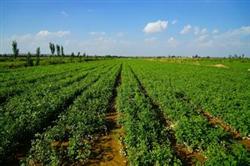 1. Site selection and land preparation: For cultivating licorice, choose sandy loam soil with deep soil layers and a low groundwater table, and plowing about 30 cm is sufficient. At present, flat planting is mostly practiced, and raised beds are rarely used; for good drainage and irrigation, the land can also be prepared into small beds and base fertilizer applied. Land preparation is best done by autumn plowing; spring plowing must preserve soil moisture, otherwise it will affect seedling emergence and seedling survival. 2. Propagation methods: In production, seed propagation is the main method, and rhizome propagation can also be used.
(1) Seed propagation: before sowing, soak the seeds in 60°C warm water for several hours, grind them for half an hour with an equal amount of crushed glass mixed with the seeds, or soak the seeds in concentrated sulfuric acid (concentrated sulfuric acid:water = 1:1.5) for about 1 hour. Spring sowing is in March to April, and autumn sowing is in August to September. For drilling, open shallow furrows at a row spacing of 50 cm and a furrow depth of 3 cm, evenly scatter the seeds into the furrows, and then cover with soil. For hole sowing, open holes at a spacing of 10-15 cm, sow 3-5 seeds per hole, and use 2-3 kg of seed per mu. After sowing, keep the soil moist; grass can be covered on the seedbed, and water should be given when the soil layer is dry. Seedlings emerge two to three weeks after sowing.
(2) Rhizome propagation: in spring and autumn, dig out the rhizomes, cut them into small sections about 5 cm long, each section should have 1-2 buds, and bury them underground to a depth of about 20 cm according to soil moisture.
(3) Division propagation: many new plants can sprout on their own beside old licorice plants; dig them out and plant them in spring or autumn.
3. Field management: (1) Irrigation: it should be determined according to soil type and salinity-alkalinity: for sandy soil with no salinity-alkalinity or slight salinity-alkalinity, irrigation can be done after sowing; for heavy clay soil or soil with relatively heavy salinity-alkalinity, irrigate before sowing and sow while the soil moisture is sufficient, and do not irrigate after sowing, so as to avoid soil compaction and an increase in salinity-alkalinity. The key to artificially cultivating licorice is preserving seedlings; generally, no watering is carried out after the plants have grown. (2) Intertillage and weeding: generally, intertillage and weeding are carried out in the same year as seedling emergence; from the second year on, licorice roots tiller, and weeds find it difficult to compete with them, so intertillage and weeding are not needed. (3) Fertilization: sufficient base fertilizer should be applied before sowing, and barnyard manure is preferable. During the growing season each year, phosphate fertilizer can be applied as a topdressing in early spring; licorice roots have root nodules and have nitrogen-fixing ability, so they generally are not deficient in nitrogen.