Key Technical Points for Summer Management of Open-Field Eggplant Cultivation
How to manage open-field eggplants in summer? Please explain. For summer open-field eggplants, you can refer to the following management methods: Eggplants like water but are not tolerant of waterlogging, yet shortly after transplanting they encounter the rainy-and-hot season of July and August, and this kind of weather poses a great threat to the normal growth of eggplants and also makes manual management more difficult. The most...
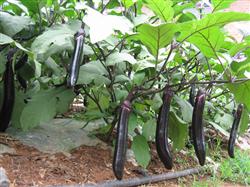
How to manage open-field eggplants in summer? Please explain
For summer open-field eggplants, you can refer to the following management methods:
Eggplants like water but are not tolerant of waterlogging, yet shortly after transplanting they encounter the rainy-and-hot season of July and August, and this kind of weather poses a great threat to the normal growth of eggplants and also makes manual management more difficult. Recently, quite a few vegetable growers have called our newspaper to ask about methods for managing open-field eggplants. In response, our reporter interviewed Professor Zou Zhirong, a member of our newspaper's expert advisory group and a protected horticulture expert at Northwest A&F University. He pointed out that summer management of open-field eggplants requires special attention to the following three aspects: proper water control, rational fertilization, and timely prevention and control of pests and diseases.
Proper water control
First, regarding cultivation conditions, sandy loam soil on higher ground should be chosen for cultivation as far as possible, and the soil must be kept moist to ensure normal growth of eggplants. When soil moisture is insufficient, plant growth will slow down and flower and fruit drop will be caused. Therefore, when settling the roots, water thoroughly with "root-setting water" to promote rapid root growth, and also water heavily once more in the early harvest stage to promote rapid fruit expansion; during the intermediate growth stage, simply keeping the soil moist is enough.
Rational fertilization
Eggplants have a long growth period, so base fertilizer must be applied heavily and topdressing must be done in a timely manner. Eggplants have a very high demand for nitrogen fertilizer, but it should not be applied excessively in high-temperature seasons. "In topdressing ammonia fertilizer, many vegetable growers combine it with irrigation, but in fact in high-temperature seasons this method is not ideal," Zou Zhirong said, because excessively high temperatures will not only cause ammonia fertilizer to volatilize but may also cause ammonia poisoning in eggplants, so it is recommended to apply it in furrows. "Eggplant leaves are large, so foliar topdressing is recommended when necessary; potassium dihydrogen phosphate works well, but be careful to control the concentration."
Timely prevention and control of pests and diseases
Summer is hot and humid, and eggplant pests and diseases occur severely, especially Verticillium wilt and Phytophthora fruit rot. Verticillium wilt, commonly known as "half-side madness," is one of the main diseases of open-field eggplants. Zou Zhirong said that the most direct way to treat Verticillium wilt is to use Torubamu as rootstock at the seedling stage and use the cleft grafting method to solve it. For plants that have already become diseased, 77% Keshade wettable powder 800-1000 times solution can be used for root drenching, generally once about every 10 days, and 2-3 consecutive treatments are enough. Of course, for particularly severely affected plots, plants should be pulled out in time, and quicklime should be scattered on the spots where the diseased plants were removed for sterilization treatment.
Eggplant Phytophthora fruit rot is also called "rotten eggplant." This disease mainly harms the fruit; fruits near the ground become diseased first and gradually spread upward. Therefore, in management, field drainage should be done well to ensure there is no water accumulation after rain, and diseased leaves and diseased fruits should be removed in time to reduce infection; cultivation should also be strengthened, and phosphorus and potassium fertilizers should be applied more to improve plant disease resistance. In the early stage of the disease, use 69% Anke Mancozeb wettable powder, and at the same time note that the spray volume on the ground, stem base, and branches and leaves should be larger, as this helps improve control efficacy.
Click to get more eggplant cultivation techniques
Click to get more vegetable cultivation techniques