Why does rice produce empty and blighted grains, and how should it be prevented and controlled?
Why does rice produce empty and blighted grains, and how should it be prevented and controlled? Please give a detailed introduction. Under normal conditions, the rate of empty and blighted rice grains is generally 10%-20%, and in severe cases can reach 40%, which greatly affects rice yield. 1. Causes of formation. The rate of empty and blighted rice grains is mainly affected by 3 factors. 1. Climatic...
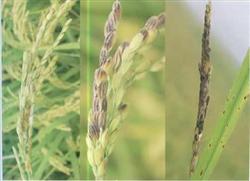
Why does rice produce empty and blighted grains, and how should it be prevented and controlled? Please give a detailed introduction.
Under normal conditions, the rate of empty and blighted rice grains is generally 10%-20%, and in severe cases can reach 40%, which greatly affects rice yield.
1. Causes of formation
The rate of empty and blighted rice grains is mainly affected by 3 factors.
1. Climatic factors. During the growth and development of rice, especially at the heading and flowering stage, environmental conditions are unsuitable. For example, if the temperature exceeds 35% or falls below 20°C, or if there are many cloudy and rainy days or excessive drought, the development of rice panicles and pollination and fertilization will be affected, making pollination difficult and thereby increasing the rate of empty and blighted rice grains.
2. Cultivation factors. Unreasonable fertilization, excessive planting density, poor drainage in the paddy field or long-term deep flooding, excessively long or heavy field drying at the mid-stage, and too early water cutoff at the late stage, as well as premature plant senescence, all affect pollination and fertilization. This greatly increases the rate of empty and blighted grains.
3. Disease and insect factors. When rice is damaged by diseases and insects and control is not timely, the rate of empty and blighted grains will also increase.
2. Prevention and control methods. In addition to strengthening cultivation management, using the following mixed solution can greatly reduce the rate of empty and blighted rice grains: Shengnongsu 10 g + gibberellin 0.5 g + boron fertilizer 100 g + water 15 kg, sprayed once each at the rice boot-breaking stage and the heading stage. In areas where rice blast, rice false smut, and sheath blight are severe, add copper sulfate 25 g + table salt 50 g + vinegar 100 g to the above mixed solution. This can not only rapidly eliminate the diseases, but also increase fertilization and reduce empty and blighted grains. If there are insect pests, add Dusai'er 10 g.
Shengnongsu can significantly reduce empty and blighted grains. Its main effects are: (1) It can make rice heading uniform, improve the vigor of female and male flowers, promote pollen tube elongation, prevent pollen abortion, and enhance pollination and fertilization capacity; (2) It enhances photosynthesis, makes plants robust, prevents physiological premature senescence, and enhances resistance to the effects of adverse environments such as continuous rainy weather, dry hot wind, and insufficient light on rice, especially enhancing pollination and fertilization capacity at low temperatures; (3) It enhances pesticide efficacy and fertilizer efficacy, improves the disease-preventing and insect-killing effects of pesticides, and enables damaged rice to recover healthy growth as quickly as possible.
Click to get more rice planting techniques
Click to get more grain crop planting techniques