Common Summer Eggplant Pests and Diseases and Their Control Methods
Which pests and diseases need to be controlled in summer eggplant? The following are several pests and diseases that need to be controlled in summer eggplant for reference: I. Control of eggplant insect pests 1. Red spider mite: For agricultural control, keep the soil moist regularly, avoid excessive drought, remove weeds and fallen leaves in time, and reduce sources of the pest. For chemical control, strengthen...
Which pests and diseases need to be controlled in summer eggplant? Please explain
The following are several pests and diseases that need to be controlled in summer eggplant for reference:
I. Control of eggplant insect pests
1. Red spider mite: For agricultural control, keep the soil moist regularly, avoid excessive drought, remove weeds and fallen leaves in time, and reduce sources of the pest. For chemical control, strengthen pest monitoring, keep it at the spot-and-patch occurrence stage, and use 73% propargite emulsifiable concentrate at 1200 times dilution, 40% dimethoate emulsifiable concentrate at 1000 times dilution, or similar agents for spray control.
2. Aphids: For control methods, it is best to apply pesticide early and keep them at the spot-and-patch occurrence stage. For agricultural control, clean up residual plants and fallen leaves in the field in time after vegetable harvest and remove weeds. For chemical control, use 2.5% deltamethrin emulsifiable concentrate at 2000-3000 times dilution, 50% pirimicarb at 2000 times dilution, 20% lübaosu at 2500 times dilution, or similar agents for spray control.
3. Whiteflies: For control methods, add insect-proof nets, and cover with silver-gray plastic film and yellow sticky boards. Whiteflies have a negative taxis to silver-gray, so silver-gray plastic film can effectively repel whiteflies. Where whiteflies have already occurred in the greenhouse, their taxis to yellow can be used by setting yellow sticky boards to trap and kill them. For chemical control, use lücaibao plus shijiening, 1 tube each, mixed with 15 kg of water for spray control. In addition, plant growth regulators such as Fengshou No. 1 and Yunda 120 can also be sprayed to alleviate the adverse effects of the pests on functional leaves.
4. Mites: Use 36% ketomite emulsifiable concentrate at 1000-1500 times dilution, 5% cascad emulsifiable concentrate at 2000 times dilution, 1.5% abadin emulsifiable concentrate at 3000 times dilution, or similar agents for spray control.
5. Leafminers: When there are 3 larvae on a leaf, before the larvae reach the 2nd instar (when the mines are very small), after the dew dries from 8:00 to 11:00, when the larvae begin to move on the leaf surface or many larvae emerge from the mines, start spraying 25% banqianjing emulsifiable concentrate at 1500 times dilution or 5% yitaibao emulsifiable concentrate at 2000 times dilution. The best control timing is from 8:00 to 12:00 during the peak of adult emergence.
II. Control of eggplant diseases
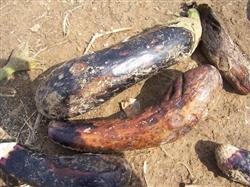
1. Phytophthora fruit rot: Phytophthora fruit rot damages fruits, stems, leaves, flowers, and other parts. The symptoms are that fruits near the ground are affected first, with round, sunken lesions that turn dark brown and rot, and white mycelium grows when the temperature is high. When stems are affected, they become water-soaked and constricted, white mold grows when the temperature is high, and the upper branches and leaves wilt. When leaves are affected, water-soaked brown lesions form, with relatively obvious concentric rings. For chemical control, use Anke 20 g + 80% Dacotech 75 g + Yunda 120 30 mL mixed with 45 kg of water for spraying, once every 7-10 days, for 3-4 consecutive sprays. Do not neglect the stem base when spraying.
2. Verticillium wilt: Eggplant Verticillium wilt is commonly known as "half-yellow, half-mad." Symptoms begin to appear after fruit set and mostly develop from the bottom upward or from one side to the whole plant. The symptoms are that in the early stage, the areas between the leaf veins turn yellow, gradually turn brown, and the edges die or the whole leaf turns yellow and withers; diseased leaves of the plant develop from the bottom upward; at first they wilt at noon and can still recover in the morning and evening; later the leaves fall off and the whole plant dies; when roots and stems are cut longitudinally, the vascular bundles can be seen turning brown or black. In the early stage of the disease, promptly drench the roots with 50% carbendazim wettable powder at 500 times dilution or 50% thiophanate-methyl wettable powder at 500 times dilution, using about 0.25 kg of solution per plant, once every 7-10 days, for 2-3 consecutive drenchings.
3. Powdery mildew: In the late full-fruit stage, to prevent premature aging of the plants, timely topdressing can reduce the severity of the disease; pay attention to reasonable irrigation and timely drainage after rain; strengthen intertillage and hilling to promote root growth of the plants; promptly remove diseased and old leaves from the lower part of the plants, which both reduces inoculum sources and helps ventilation and light penetration. In the early stage of the disease, spray 15% triadimefon wettable powder at 1000 times dilution, 40% Fuxing emulsifiable concentrate at 4000 times dilution, or 40% duoliu suspension concentrate at 500-600 times dilution.
4. Viral disease: For chemical control, use 1.5% zhibingling emulsifiable concentrate at 1000 times dilution or 20% virus A wettable powder at 500 times dilution, spraying once every 7-10 days for 2-3 consecutive times.
Click to get more eggplant cultivation techniques
Click to get more vegetable cultivation techniques