How should eggplants be managed during summer planting for the best results?
How should eggplants be managed well when planted in summer? Please explain. Summer eggplants, because their growing period falls in a season of high temperatures, frequent rain, and frequent pests, diseases, and weeds, have low and unstable yields. To achieve an ideal yield, the following field management measures should be carried out well: 1. Apply the "three" fertilizers properly: after the seedlings survive transplanting, apply a good seedling-promoting fertilizer, applying 1000 kg of 20% human excrement and urine per mu or applying 10-15 kg of compound fertilizer in holes; when the first eggplant fruit swells, apply a good first-fruit fertilizer, applying 1500 kg of human excrement and urine or applying 15 kg of compound fertilizer in holes; apply a good fruit-fattening fertilizer, applying 2000 kg of human excrement and urine or 20 kg of compound fertilizer when eggplants enter the fruiting stage.
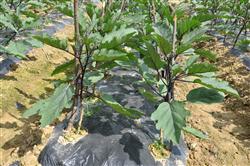
How should eggplants be managed well when planted in summer? Please explain.
Summer eggplants, because their growing period falls in a season of high temperatures, frequent rain, and frequent pests, diseases, and weeds, have low and unstable yields. To achieve an ideal yield, the following field management measures should be carried out well:
1. Apply the "three" fertilizers properly: after the seedlings survive transplanting, apply a good seedling-promoting fertilizer, applying 1000 kg of 20% human excrement and urine per mu or applying 10-15 kg of compound fertilizer in holes; when the first eggplant fruit swells, apply a good first-fruit fertilizer, applying 1500 kg of human excrement and urine or applying 15 kg of compound fertilizer in holes; apply a good fruit-fattening fertilizer, applying 2000 kg of human excrement and urine or 20 kg of compound fertilizer when eggplants enter the fruiting stage.
2. Manage the "three" waterings well: in addition to watering well for root establishment, when the fruit begins to develop and the calyx is exposed, water well to stabilize the fruit to ensure young fruit growth, and water heavily for fruit fattening, as the fruit develops fastest at this time, irrigating more than half the furrow so that the soil is fully moist and then drains naturally; 2-3 days before harvest, water lightly once to plump the skin so the fruit grows fully.
3. Pruning: the branching and fruiting habits of eggplant are quite regular. For the angular-layer branches, retain the two symmetrical branches growing diagonally or horizontally from the opposite fork, and remove all other branches, especially those growing vertically upward. For shoot removal, after the first eggplant fruit has set steadily, remove all axillary buds that develop below it; on the second eggplant fruit and "April eggplant" and above, in addition to promptly removing axillary buds, also pinch off the growing tips, so that each plant can be ensured to bear 5-7 fruits.
4. Cultivation and weeding: the vigorous growth stage of eggplant is also the period of vigorous weed growth. Therefore, cultivation, weeding, and hilling should be combined, carried out 2-3 times before the rows close in, to eliminate weed infestation, prolong moisture conservation time, and hill the soil. Once the rows have closed in, no further cultivation should be carried out.
5. Disease prevention and control: the pests and diseases that cause summer eggplant yield reduction and even loss of commodity value include phytophthora blight, brown spot disease, and shoot borers. To prevent phytophthora blight, use 70% Dexon at 500-600 times dilution or 70% chlorothalonil at 600 times dilution; to prevent brown spot disease, use 65% zineb at 500-600 times dilution; the best time to control shoot borers is when the inflorescence of the next node is elongating and the inflorescence of the previous node has not yet elongated, and 2.5% Kung Fu at 4000 times dilution or 20% Meisaoli at 800 times dilution can be used.
6. Harvesting: when a ring-shaped node from white to light green appears on the eggplant, it should be harvested promptly for market.
Click to get more eggplant cultivation techniques
Click to get more vegetable cultivation techniques