Garlic Cultivation Techniques: How to Prevent and Control Garlic Leaf Blight?
How to prevent and control garlic leaf blight? Please provide an introduction to the methods. An introduction to garlic leaf blight and its control methods for reference: 1. Symptoms: It mainly affects leaves or flower stalks. Leaf infection mostly starts at the leaf tip or other parts of the leaf, initially appearing as small round white spots that expand into irregular or elliptical grayish-white or grayish-brown lesions, on which...
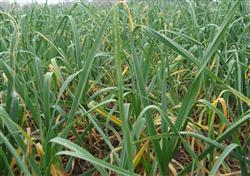
How to prevent and control garlic leaf blight? Please provide an introduction to the methods.
An introduction to garlic leaf blight and its control methods for reference:
I. Symptoms: It mainly affects leaves or flower stalks. Leaf infection mostly starts at the leaf tip or other parts of the leaf, initially appearing as small round white spots that expand into irregular or elliptical grayish-white or grayish-brown lesions, on which black mold-like growth develops; in severe cases, the diseased leaves wither and die. Infected flower stalks tend to break at the diseased area, and eventually many small black granules are scattered on the diseased part. When the damage is severe, no scapes are produced.
II. Disease factors: It mainly overwinters in the soil as mycelium or perithecia with diseased plant residues, and the following year releases ascospores to cause primary infection, after which conidia are produced from diseased areas for secondary infection. This fungus is a weak parasite and often occurs mixed with downy mildew or purple blotch.
III. Control measures:
(1) Promptly remove damaged leaves and flower stalks. (2) Strengthen field management, maintain reasonable planting density, drain water promptly after rain, and improve host disease resistance. (3) At the beginning of the disease, spray 75% chlorothalonil wettable powder at 600 times dilution, or 50% iprodione wettable powder at 1500 times dilution, 64% oxadixyl-mancozeb wettable powder at 500 times dilution, 50% copper bis(dihydrogen phosphate) wettable powder at 500 times dilution, 60% copper bis(dihydrogen phosphate) wettable powder at 500 times dilution, 14% copper ammonia complex aqueous solution at 300 times dilution, or 1:1:100 Bordeaux mixture, once every 7-10 days, for 3-4 consecutive applications.
Click to get more garlic cultivation techniques
Click to get more vegetable cultivation techniques