Detailed Explanation of Late-Stage Management Techniques for Garlic Cultivation
How should garlic be managed in the late stage of cultivation? Please provide an introduction. During the symbiotic period of garlic scape elongation and bulb swelling, adequate water and nutrients are needed, along with moderately low soil temperature. Therefore, fine management should be carried out according to different plots and different disease severity levels. For normal disease-free plots, heavy irrigation should be applied, watering thoroughly and deeply, with a per-mu...
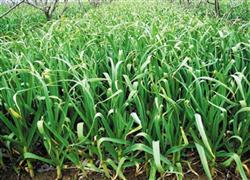
How should garlic be managed in the late stage of cultivation? Please provide an introduction.
During the symbiotic period of garlic scape elongation and bulb swelling, adequate water and nutrients are needed, along with moderately low soil temperature. Therefore, fine management should be carried out according to different plots and different disease severity levels. For normal disease-free plots, heavy irrigation should be applied, watering thoroughly and deeply, with a per-mu application of water-soluble flush fertilizer or reasonably soluble compound fertilizer or soluble seaweed acid, such as humic acid, amino acid and other fertilizers, at 10-15 kg. Plots that have not been watered or fertilized are mostly continuous-cropping diseased plots; for these, light irrigation should be applied, with a per-mu application of soluble seaweed acid (humic acid, amino acid) fertilizer at 5-10 kg, along with foliar topdressing, spraying foliar fertilizer or a diluted solution of 0.5% urea + 0.3% monopotassium phosphate, once every 5-7 days. As for continuous-cropping disease, that is, plots with more severe yellowing of leaves, watering should be done at the appropriate time according to soil moisture conditions, with foliar topdressing carried out first, spraying foliar fertilizer or a diluted solution of 0.5% urea + 0.3% monopotassium phosphate, once every 5-7 days, and watering at the appropriate time.
Comprehensive prevention and control of pests and diseases should not be overlooked either. Before and after watering, fungal fungicides should be sprayed, such as iprodione or thiophanate-methyl plus bacterial fungicides like validamycin, along with one application of foliar fertilizer, to prevent the occurrence of garlic diseases.
For the prevention and control of garlic continuous-cropping (yellow leaf) disease, bacterial fungicides can be selected, such as zhongshengmycin, kubizhi, etc., combined with fungal fungicides such as baitai, duoning, and foliar fertilizer used alternately, sprayed once every 5-7 days.
In addition, combined with watering, 500 ml of phoxim emulsifiable concentrate plus 50 ml of avermectin emulsifiable concentrate or 500 ml of chlorpyrifos emulsifiable concentrate can be applied per mu as a soil flush, to control garlic root maggots and root mites.
Click to get more garlic cultivation techniques
Click to get more vegetable cultivation techniques