What are the propagation methods of Angelica sinensis?
How many methods are there for propagating Angelica sinensis? Please provide an introduction. Angelica sinensis is propagated by seed, generally using the method of raising seedlings and then transplanting, though direct sowing can also be used. 1. Raising seedlings and transplanting (1) Selecting seeds: After seed selection, Angelica sinensis yields about 14.6 kg more per mu than unselected seeds. The main selection method is selecting by seed head. At harvest time for Angelica sinensis, when the seed coat...
How many methods are there for propagating Angelica sinensis? Please provide an introduction.
Angelica sinensis is propagated by seed, generally using the method of raising seedlings and then transplanting, though direct sowing can also be used.
1. Raising seedlings and transplanting
(1) Selecting seeds: After seed selection, Angelica sinensis yields about 14.6 kg more per mu than unselected seeds. The main selection method is selecting by seed head. At harvest time for Angelica sinensis, when the seed coat turns azure blue or pink and the flowering stem droops, select fruit heads that have the characteristics of this variety, are growing well and robustly, are free of pests and diseases, and are highly mature, cut them off together with the flowering stem, and dry them in a well-ventilated place, then thresh and store for later use. Because Angelica sinensis seeds do not mature uniformly, seed collection must be carried out in batches, cutting one head at a time as it matures, and removing moldy, mixed, shriveled, and pest- or disease-damaged seeds. Use plump, well-filled seeds for planting, and never harvest whole plants or whole plots at once. To ensure seed quality, a germination test should also be done before sowing.
(2) Pre-sowing treatment: To make seeds germinate quickly and emerge uniformly after sowing, soaking treatment is often carried out before sowing in production, so that the seed coat absorbs water and softens in a short time, increasing permeability and promoting seed germination. The seed treatment method for Angelica sinensis is to soak the seeds in warm water at 25-30°C for 24 hours, take them out and dry them in the sun, then mix them with plant ash at a ratio of 1:10.
(3) Sowing time: The suitable sowing period should be determined according to local conditions such as altitude and temperature, and it should not be too early or too late. If too early, early bolting is likely to occur; if too late, the seedlings are too small, have poor stress resistance, and have a low survival rate. In low-temperature, high-altitude areas, sowing is suitable in early to mid-June; in slightly warmer, low-altitude areas, sowing is suitable from mid-July to early August. Regardless of whether sowing is early or late, seedling age must not exceed 110 days, and the weight of 100 seedlings must not exceed 40 grams.
(4) Sowing method: Broadcast sowing is generally used for raising seedlings, though drilling can also be used. For broadcast sowing, scatter the seeds evenly on the seedbed, cover with a layer of fine fertile soil about 0.5-1.0 cm thick, then cover with about 3-5 cm of dry straw to keep warm and preserve moisture. In places with little rainfall, sowing is best done before rain so that seedlings emerge uniformly and robustly. For drilling, open horizontal furrows at a row spacing of 20 cm, with a furrow depth of 3-5 cm. When sowing, scatter the seeds evenly in the furrows, cover with fine soil so that the seeds are no longer visible, then cover the bed with dry straw or build a shade frame.
(5) Seeding rate: The yield per unit area of Angelica sinensis is composed of the number of plants and the root weight per plant. The amount sown and whether sowing is uniform will affect the later growth and yield of the seed plants. If the seeding rate is too low, although growth is fast and roots are large and heavy, large seedlings and forked seedlings are easily formed, and early bolting is likely after transplanting. If the seeding rate is too high, small and weak seedlings are easily formed, the survival rate after transplanting is low, and planting costs increase. In production, the seeding rate is about 4-5 kg per mu for broadcast sowing and about 4 kg for drilling.
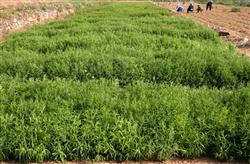
(6) Seedling stage management: To increase the seed germination rate and make seedlings uniform and strong, the seedbed must be kept moist after sowing, while covering with grass to preserve moisture. After sowing, seedlings generally emerge in 15-20 days. If the soil is moist and the temperature is suitable, they can emerge in 7-8 days. Newly emerged seedlings are easily killed by strong sunlight, so the covering grass should be loosened to shade the seedlings. After 1 month, when the seedlings grow to a height of 1-2 cm, part of the covering grass on the bed surface should be removed. After removing the grass, build a shade frame or use black netting for shade, with a height of about 60 cm, and control the shading degree to 1/3-1/2 of full sunlight. Remove the shade material after the hottest summer period.
When the seedlings grow 3 true leaves and reach a height of 3 cm, the first loosening of the soil and thinning can be carried out, removing weak and diseased seedlings and maintaining a plant spacing of about 1 cm. Remove field weeds at any time.
To prevent excessive seedling growth and the formation of large seedlings that bolt early after transplanting, fertilizer is generally not applied during the seedling stage. Only in the later stage of seedling growth should human manure or an appropriate amount of ammonium bicarbonate be applied.
(7) Lifting and storing seedlings: Seedlings are not suitable for overwintering in the open field, because open-field overwintering seedlings have poor drought resistance and a high bolting rate after passing through vernalization in the field, so seedlings should be dug up and stored before the ground freezes. The best time to lift seedlings is when the temperature drops to about 5°C and the aboveground leaves begin to turn yellow. In Gansu production areas, this is generally around Cold Dew. In Sichuan production areas, it is around Frost's Descent. Lifting seedlings should be done on sunny days to prevent rain from causing root rot. When lifting seedlings, use a small shovel to dig up the seedlings, pull them out, and strive to keep the root system intact. Damaging buds and root bodies is strictly prohibited. Then shake off the soil, cut off the leaves while retaining a 1 cm long petiole, remove diseased, damaged, injured, and rotten seedlings, then divide them into large, medium, and small groups, tie every 100 plants into a bundle, and place them on dry raw soil in a cool, dry place to air-dry for 5-7 days, so that the outer skin of the fresh seedlings dries slightly, the root body begins to soften (water content 60-65%), and the petioles shrink, after which they can be stored. Never air-dry for too long, causing excessive water loss from the seedlings. There are two methods of seedling storage: pit storage and dry storage. Dry storage has the strongest drought resistance, while pit storage has relatively poor drought resistance. If conditions permit, frozen storage below 0°C is best.
Dry storage is called heap storage. In a smokeless, windproof room, use dry adobe to build a square pit 100 cm long and 100 cm wide. Spread a layer of soil on the bottom of the pit, then place the seedlings from the center outward in one layer, with the tails toward the center and the heads outward. In the outermost ring of each layer, leave a gap 6 cm wide between the seedling heads and the pit wall. In this way, alternate one layer of seedlings and one layer of soil until the pit is full, finally covering with a layer of thick soil, with the top shaped like a fish back. A pit may also be omitted, and storage can be done layer by layer on the ground, finally covering with soil in a steamed bun shape. If the number of seedlings is small, baskets can also be used for stratified storage.
For pit storage, choose a dry, cool place without rat holes and without water seepage to dig the pit. The size of the pit depends on the number of seedlings, and the shape may be rectangular or round. First spread a layer of raw soil with suitable moisture about 3 cm thick on the bottom of the pit, then place a layer of seedlings and spread a layer of soil, storing 6-7 layers in this way, about 65-75 cm high, and finally cover with soil on top higher than the ground to prevent water accumulation from causing rot. When placing seedlings, alternate heads and tails and arrange them neatly.
(8) Transplanting: To reduce the bolting rate, seedlings used for planting must be strictly selected. Generally, seedlings are required to have intact roots, no pests or diseases, straight roots, and few forked roots, with a thickness of 3-5 mm. Oversized seedlings easily bolt, while undersized seedlings are too weak and grow poorly. Spring planting is mostly used in Angelica sinensis production. Because altitude, temperature, and other conditions vary from place to place, transplanting time differs. Spring temperatures are unstable; if transplanting is too early, seedlings are easily killed by late frost after emergence; if transplanting is too late, the seedlings have already sprouted, later development is poor, and seedlings are easily damaged, affecting survival. Generally, it starts after Qingming and ends before Grain Rain.
In recent years, Min County, Gansu, has changed spring planting to winter planting. After several years of experiments, high yields were obtained, increasing yield by more than 10% compared with spring planting. That is, seedlings raised in the current year are transplanted into the field from Cold Dew to Frost's Descent, and harvested in the autumn of the following year together with spring-planted Angelica sinensis. The advantages of winter planting are stable roots and strong seedlings, earlier greening in the following year, and reduced losses from disease infection and mold during winter storage.
Transplanting methods differ from place to place. In Sichuan production areas, holes are dug on the bed to plant seedlings, with a hole spacing of 30 cm and a row spacing of 36 cm, planting 2-3 seedlings per hole, requiring 10,000-15,000 seedlings per mu. When planting, the roots should be spread out and not bent. After filling with a little soil and pressing firmly, apply barnyard manure, about 750 kg per mu, then cover with fine soil 3 cm above the root heads to prevent late frost damage. Min County, Gansu, uses hole planting or furrow planting. Hole planting means digging holes in a triangular staggered pattern on prepared land at a plant-row spacing of 24×33 (cm2), with a hole depth of 18-21 cm and a hole diameter of 12-15 cm, about 6,000-8,000 holes per mu, placing one large, one medium, and one small seedling in each hole, generally requiring 15-20 kg of clean seedlings per mu. Place the seedlings vertically in the holes and cover with soil. Covering with soil higher than the ground is called "open hole," mostly used on land with loose soil and fine land preparation; planting seedlings along the slope with root heads outward and root tails inward laid flat in the hole is called "upward hole," mostly used on sloping land, which helps maintain soil moisture and prevents root heads from being exposed after rain. After transplanting, cover with 2-3 cm of soil and press lightly. Furrow planting means opening horizontal furrows on the prepared bed surface, with a furrow spacing of 40 cm and a depth of 15 cm, placing large, medium, and small seedlings alternately in the furrows at a plant spacing of 3-5 cm, with the rhizome 2 cm below the bed surface, and covering with 2-3 cm of soil.
To make Angelica sinensis develop uniformly, some spare seedlings should be planted at the field edge or beside the bed at the same time as transplanting, in case they are needed to fill gaps.
2. Direct sowing
To prevent early bolting of Angelica sinensis, cultivation scientists conducted a great deal of research and changed summer seedling raising and transplanting to autumn direct sowing, controlling seedling size. This not only prevented early bolting but also reduced procedures such as raising seedlings, lifting seedlings, storing seedlings, and planting seedlings, saving labor and reforming cultivation techniques. According to the results of experiments on different sowing dates conducted by the Northwest Institute of Botany in 1975, autumn sowing can effectively prevent early bolting. However, the time of autumn sowing must be controlled, and sowing must be done around the Start of Autumn. If too early, the purpose of preventing bolting cannot be achieved; if too late, the seedlings have poor resistance. In short, it should be ensured that the seedlings of the current year have a growth period of about 70 days, grow 3-4 true leaves, and have a root diameter of about 0.2 cm before they can overwinter safely. In places with high altitude and low temperature, sow in early August; in places with low altitude and high temperature, it can be delayed to mid-August to early September.
Because direct sowing cultivation does not have the problem of early bolting, it is advisable to choose fully mature and plump "gunpowder seeds" as seed. This kind of seed is rich in nutrients and highly viable, and after sowing, seedlings emerge quickly and uniformly and grow vigorously. In addition, the single root weight of direct sowing is slightly lower than that of raising seedlings and transplanting, so production generally relies on increasing population density to increase yield. At the same time, because its growth cycle is short, in order to obtain high yield, in addition to applying sufficient base fertilizer, timely topdressing should also be carried out, applying more nitrogen fertilizer at the seedling stage and applying phosphorus and potassium fertilizer early after the seedlings are established.
For direct sowing land, choose a sunny plot with gentle slope and lower altitude, requiring deep soil layers, fertile and loose soil, and rich organic matter. Direct sowing methods are divided into hole sowing and drilling, with hole sowing being better. For hole sowing, open holes on the bed in a plum blossom pattern at a hole spacing of 27 cm, with a depth of 3-5 cm and a flat hole bottom, sowing about 10 seeds per hole in a radiating scatter. For drilling, open horizontal furrows on the prepared bed surface, with a furrow depth of 5 cm and a furrow spacing of 30 cm, and scatter seeds evenly in the furrows. Whether drilling or hole sowing, lightly step on the furrows or holes to press them slightly so that the seeds are in close contact with the soil, then cover with fine fertile soil about 1 cm thick, rake the bed surface smooth, and cover with a layer of short grass or fallen leaves to help retain moisture. Usually, the seeding rate per mu is 0.75-1 kg for hole sowing and 1.5-2 kg for drilling.
Direct-sown Angelica sinensis seedlings overwinter in the field and are prone to freezing damage, so some measures must be taken to protect the seedlings, such as covering manure and soil over the seedlings in combination with pre-winter topdressing, and watering in winter to prevent freezing.
Click to get more Angelica sinensis cultivation techniques
Click to get more medicinal herb cultivation techniques