How should late-stage premature senescence in cotton be managed to prevent and control it?
How can management prevent and control late-stage premature senescence in cotton? Please provide methods. To prevent and control late-stage premature senescence in cotton, you can refer to the following methods: 1. Fertilizer and water management: According to the condition of the cotton plants, the climate and the soil conditions, apply the flowering and boll fertilizer heavily; if the flowering and boll fertilizer is insufficient, then apply a top-dressing fertilizer. After mid-August, if the maximum field water-holding capacity is below 60%, and in early September below 55%, water promptly to promote fertilizer with water and ensure the fertilizer effect is exerted in time. If cotton premature senescence is caused by soil potassium deficiency, while applying base fertilizer, increase the application of potassium sulfate or potassium chloride by 5-10 kg during the seedling and bud stages. When fertilizing, be sure to plow deeper than 20 cm, apply the fertilizer at the plow bottom, achieve deep fertilizer application, promote root penetration downward, reduce fertilizer loss, and improve fertilizer use efficiency. During the flowering and boll-setting stage, if drought occurs, water lightly, carefully clean the furrows and beds to prevent waterlogging again; if waterlogging occurs, drain promptly.
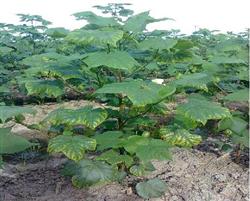
How can management prevent and control late-stage premature senescence in cotton? Please provide methods.
To prevent and control late-stage premature senescence in cotton, you can refer to the following methods for management:
I. Fertilizer and water management: According to the condition of the cotton plants, the climate and the soil conditions, apply the flowering and boll fertilizer heavily; if the flowering and boll fertilizer is insufficient, then apply a top-dressing fertilizer. After mid-August, if the maximum field water-holding capacity is below 60%, and in early September below 55%, water promptly to promote fertilizer with water and ensure the fertilizer effect is exerted in time. If cotton premature senescence is caused by soil potassium deficiency, while applying base fertilizer, increase the application of potassium sulfate or potassium chloride by 5-10 kg during the seedling and bud stages. When fertilizing, be sure to plow deeper than 20 cm, apply the fertilizer at the plow bottom, achieve deep fertilizer application, promote root penetration downward, reduce fertilizer loss, and improve fertilizer use efficiency. During the flowering and boll-setting stage, if drought occurs, water lightly, carefully clean the furrows and beds to prevent waterlogging again; if waterlogging occurs, drain promptly.
II. Rational chemical regulation: To prevent premature growth of plants from causing premature senescence, the timing of chemical regulation and the dosage of mepiquat chloride should be comprehensively considered in combination with climate, soil fertility and plant appearance. This is the most important point. Generally, at the 8-leaf stage, bud stage, early flowering stage, full flowering stage and after topping, spray regulators such as cotton boll-strengthening agent in small amounts several times to achieve the purpose of rational regulation.
III. Foliar top-dressing: After August, for cotton fields deficient in phosphorus and potassium, spray 300-500 times diluted potassium dihydrogen phosphate solution once every 10-15 days, with 60-80 kg of fertilizer solution per mu. For cotton fields deficient in nitrogen, spray 200 times diluted urea solution. For foliar top-dressing, on cloudy days it can be sprayed all day, while on sunny days it should be sprayed in the evening to avoid burning the leaves.
IV. Breaking up soil crust: After rain, for cotton fields that have not yet closed rows, especially in hilly areas, loosen the soil promptly to break up the crust. Do not loosen the soil too deeply, so as not to damage the root system or destroy the earth-up. You can also spray the soil conditioner "Mian Shen Geng". Spraying "Mian Shen Geng" can break up the crust, loosen the soil, and improve soil structure; it can fully exert fertilizer efficiency, promote normal root growth, and improve root absorption capacity. Method for spraying "Mian Shen Geng": use 200 ml of the agent per mu, dilute with 50 kg of water, and spray evenly on the earth-up rows.
V. Topping and pruning: First, prune carefully and promptly, remove ineffective buds; all buds after the Beginning of Autumn or flowers after White Dew should be completely removed to reduce consumption. Second, leave fewer fruiting nodes on the lower fruiting branches: leave 1 node on the first and second fruiting branches, and 2 nodes on the third and fourth fruiting branches; once enough nodes have formed, tip the side branches early. This method can save organic nutrients and prevent late-stage premature senescence in cotton.
VI. Pest control and leaf protection: The functional period of normal leaves is generally about 8 weeks, but due to the impact of pests such as cotton bollworm, mirids and red spider mites, and diseases such as Fusarium wilt, Verticillium wilt and red leaf stem blight, leaves are damaged or shed, reducing leaf function and accelerating premature senescence. Therefore, pest control must be done well, diseases must be reduced, and leaf function must be prolonged. In the early stage of Verticillium wilt, use 40% carbendazim 1000 times diluted solution for root irrigation (0.5 kg per plant), or use 500 times diluted fulvic acid salt mixed with an appropriate amount of New High Lipid Film for spray control.
Click to get more cotton cultivation techniques
Click to get more grain crop cultivation techniques