How to identify and control brown spot disease of Angelica sinensis?
What is brown spot disease of Angelica sinensis? How to control it? Please provide guidance. The pathogen of brown spot disease of Angelica sinensis is a fungus of the genus Septoria in the subphylum Deuteromycotina. The pycnidia are round, and the conidia are filiform to needle-shaped, colorless and transparent, straight or slightly curved, mostly with slightly pointed tips, with 1-3 septa. 1. Damage symptoms: it damages the leaves. At...
What is brown spot disease of Angelica sinensis? How to control it? Please provide guidance.
The pathogen of brown spot disease of Angelica sinensis is a fungus of the genus Septoria in the subphylum Deuteromycotina. The pycnidia are round, and the conidia are filiform to needle-shaped, colorless and transparent, straight or slightly curved, mostly with slightly pointed tips, with 1-3 septa.
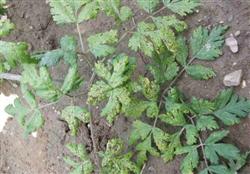
1. Damage symptoms: it damages the leaves. At the early stage of the disease, brown spots appear on the leaf surface, and the lesions gradually expand, with a chlorotic halo appearing around them, the edges appearing reddish brown, and the centers grayish white. Later, small black particles appear within the lesions. When the disease is severe, most of the leaf turns reddish brown and finally gradually withers and dies.
2. Disease development pattern: the conidia cannot tolerate low temperatures and germinate easily when exposed to moisture. Because there is no suitable host, they die, so they are not the main overwintering source of inoculum. The pathogen mainly overwinters in diseased residual tissues as pycnidia. When the temperature is suitable the following year, the pycnidia produce conidia, which spread through wind and rain and expand the damage. When the spores land on Angelica sinensis leaves, they germinate in dew droplets or water, produce germ tubes, invade through stomata, and spread and extend in the intercellular spaces of the leaf cells, causing lesions to form on the leaves and producing conidia for reinfection. The disease begins in late May, is more severe from July to August, and continues until October. High temperature and high humidity favor the disease.
3. Control measures: (1) In winter, do a good job of cleaning the field and garden, thoroughly burn diseased residual tissues, and reduce the sources of pathogens. (2) At the early stage of the disease, promptly remove diseased leaves and spray Bordeaux mixture at 1:1:150 or 500 times 65% zineb or 800-1000 times 50% thiophanate-methyl for control, spraying once about every 10 days for 3-4 consecutive times. (3) Establish disease-free seed fields and select and retain disease-free seeds. During the growth period of Angelica sinensis, carry out intertillage and weeding in time, and prevent waterlogging in the field during the rainy season to reduce damage losses.
Click to get more Angelica sinensis cultivation techniques
Click to get more medicinal herb cultivation techniques