How to grow autumn radishes for high yields? Detailed growing methods
How can autumn radishes be grown for high yields? Please explain the methods. To grow autumn radishes, you can refer to the following methods: 1. Varieties and planting time. There are many radish varieties. By season, they can be divided into four types: autumn radish, spring radish, summer radish and four-season radish. Using idle yards to grow autumn radishes...
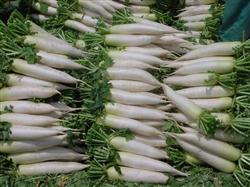
How can autumn radishes be grown for high yields? Please explain the methods for growing
To grow autumn radishes, you can refer to the following methods:
1. Varieties and planting time
There are many radish varieties. By season, they can be divided into four types: autumn radish, spring radish, summer radish and four-season radish. Excellent varieties for growing autumn radishes in idle yards include: Jinan Qingyuancui, Xinlimei, etc. If sown too early, the temperature during the seedling stage is high, making the plants susceptible to viral disease; if autumn radishes are sown too late, the growing period is insufficient, making it difficult to obtain high yields. The traditional planting time for radishes is generally suitable in early to mid-August.
2. Growing techniques
1. Land preparation and fertilization. Idle yards are generally hard in texture. After heavy rain, plow deeply early, fully sun the soil clods, break up clods, rake level, and apply sufficient base fertilizer. If the weather is dry, open furrows and irrigate, with furrow spacing of 1-1.5 m; after 2-3 days, plow deeply immediately to create soil moisture. The depth is generally suitable at 20-25 cm. Radishes have a relatively developed root system, so sufficient base fertilizer must be applied before plowing. Generally, apply 3000-4000 kg of high-quality decomposed barnyard manure and 15-20 kg of superphosphate per mu and plow them into the soil. Level and make beds so that the soil is loose, free of clods, and the beds are level. Autumn radishes are generally grown on ridges, with ridge height of about 10-15 cm, row spacing of 30-40 cm, and plant spacing of 15-20 cm.
2. Sowing. Radishes are all sown directly. When sowing, open a small furrow on top of the ridge, with a furrow depth of 4-5 cm. After opening the furrow, pour a little water along the furrow. After the water seeps in, evenly scatter the seeds into the furrow, and after sowing cover with 1.5-2 cm of fine soil. To retain moisture and prevent rain, scatter a thin layer of chopped wheat straw after sowing, and remove the chopped wheat straw the next day or before emergence.
3. Field management
1. Thinning. When the seedlings grow to the "cross" stage, carry out the first thinning. Combine thinning with cultivating and weeding, removing weeds, weak seedlings and diseased seedlings. When 3-4 true leaves have grown, carry out the second thinning, and carry out the third thinning to establish final spacing when there are 5-6 true leaves.
2. Watering and fertilizing. Radish seedlings generally do not need watering. After emergence, if the weather is dry, water lightly once; do not flood irrigate, otherwise the seedlings may be washed out, roots exposed, growth affected, and missing plants and broken rows caused. After final thinning, one topdressing can be applied. When fertilizing, open a small furrow on both sides of the ridge, apply 12-15 kg of ammonium sulfate per mu, mound soil to support the ridges, and water immediately. After radishes "break shoulder," to promote growth, topdress and water promptly and control insects. Apply 20-30 kg of ammonium sulfate per mu, open furrows and apply it on both sides, mound soil to support the ridges, and water immediately. When the third leaf ring unfolds, cultivate promptly; it is better to cultivate shallowly than deeply, otherwise the lateral roots may be damaged and growth affected. After that, water once every 6-7 days to keep the soil moist. Stop watering 8-10 days before harvest to facilitate harvesting.
Click to get more radish growing techniques
Click to get more vegetable growing techniques