Correct methods and key technical points for fertilizing cotton in the late stage
How should cotton be fertilized in the late stage? Please explain the methods. Around mid to late September is the late growth stage of cotton. During this period, the cotton root system's ability to absorb nutrients declines noticeably, but if nitrogen, phosphorus, potassium, zinc, boron and other fertilizers are sprayed on the cotton leaves, it can prevent premature senescence, promote early maturity, prevent disease, prevent boll shedding, and produce large bolls...
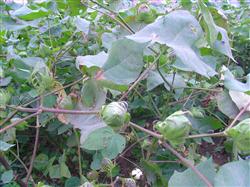
How should cotton be fertilized in the late stage? Please explain the methods
Around mid to late September is the late growth stage of cotton. During this period, the cotton root system's ability to absorb nutrients declines noticeably, but if nitrogen, phosphorus, potassium, zinc, boron and other fertilizers are sprayed on the cotton leaves, it can prevent premature senescence, promote early maturity, prevent disease, prevent boll shedding, and produce large bolls, with a significant yield-increasing effect.
(1) Apply nitrogen fertilizer to prevent premature senescence. Use 75-100 kg of 1% urea solution per mu each time, spray once every 5-7 days, for 2-3 consecutive sprays. This can enhance leaf photosynthesis and help prevent premature senescence and increase yield.
(2) Apply phosphorus fertilizer to promote early maturity. Spraying phosphorus fertilizer on cotton leaves in the late stage can promote full seeds, increase boll weight, and advance boll opening. The method is to mix 1 kg of superphosphate with 50 kg of water, soak for 12 hours, then spray, with 75 kg used per mu.
(3) Apply potassium fertilizer to prevent disease. If cotton lacks potassium in the late stage, wilt disease easily occurs during the boll-setting stage, causing severe yield reduction. The method for spraying potassium fertilizer on cotton leaves is to use 75-100 kg of 0.3% potassium dihydrogen phosphate solution per mu, spray the whole plant, and 2-3 consecutive sprays are sufficient.
(4) Apply zinc fertilizer to prevent boll shedding. Cotton is prone to zinc deficiency in the late stage, which can cause localized leaf chlorosis, wilting of young leaves, and shedding of newly set young bolls, making it difficult to retain top bolls. The method for spraying zinc on cotton leaves is to spray 75 kg per mu of 0.1%-0.2% zinc sulfate or zinc chloride aqueous solution, spray once every 5-7 days, for 2-3 consecutive sprays.
(5) Apply boron fertilizer to produce large bolls. Cotton is prone to boron deficiency in the late growth stage, which raises the node position of fruiting branches, increases side branches, causes fewer flowers and smaller bolls, and reduces yield. Timely boron fertilizer spraying helps set more bolls and larger bolls. During full bloom, spray 100 kg of 0.2% boric acid or 0.15% boric acid solution, for 2-3 consecutive sprays.
Click to get more cotton cultivation techniques
Click to get more grain crop cultivation techniques