How to grow Salvia miltiorrhiza seedlings and propagate it? Master the key technical points
How to grow Salvia miltiorrhiza seedlings and propagate it? Please explain the methods. There are several propagation methods for Salvia miltiorrhiza, such as seed seedling raising, division, root division and cuttings. In production, root division is mainly used, and this method can greatly increase yield. (1) Root division method: select healthy, pest-free, thick 0....
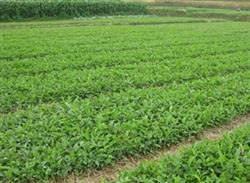
How to grow Salvia miltiorrhiza seedlings and propagate it? Please explain the methods
There are several propagation methods for Salvia miltiorrhiza, such as seed seedling raising, division, root division and cuttings. In production, root division is mainly used, and this method can greatly increase yield.
(1) Root division method: select healthy, pest-free new roots 0.7-1.0 cm thick, cut them into 5-7 cm long sections and set aside. Prepare the land, make beds and open furrows. The bed width is 1-2 m, the length is unlimited, the furrow depth is 20 cm, and the bed surface must be level. Open small furrows 3-4 cm long on the bed surface, with a furrow depth of 30 cm. Place the root sections horizontally at the bottom of the small furrows at a plant spacing of 20 cm and cover with soil until level. Or arrange the root sections obliquely on the furrow walls, or place them upright on the furrow walls (do not place them upside down), and finally cover with 7 cm of soil to form small ridges. The planting time is around the Start of Winter (mid-November) after the Salvia miltiorrhiza harvest. Seedlings emerge successively in the following spring, so flowering is relatively late, and seeds may even fail to be harvested. However, Salvia miltiorrhiza planted by this method grows roots relatively quickly and can effectively increase yield. To promote early growth of Salvia miltiorrhiza, in production practice, facilities such as plastic film mulching and plastic sheds (large, medium or small) can be used for overwintering management. This allows Salvia miltiorrhiza to start growing early in spring, make full use of light resources, and increase yield.
(2) Seed propagation method: first harvest Salvia miltiorrhiza seeds, use the seeds to raise good seedlings, and then transplant them to the field. This method has low production cost and abundant seed sources, and can be used for large-scale production. The specific operations are as follows: To increase the germination rate, Salvia miltiorrhiza can be sown immediately after seed collection, or different seedling-raising periods can be chosen according to crop rotation and local climatic conditions: in the Central Plains region, open-field seedling raising can be carried out after Qingming and before White Dew (April-October), while in winter or early spring it can be done in facilities such as greenhouses and large plastic tunnels. The thousand-grain weight of Salvia miltiorrhiza seeds is only 1.2 grams, and the general germination rate is 70%. Sowing within one year can still achieve relatively good seedling-raising results, but seeds used in the same year of collection are still the best. The seedling bed for Salvia miltiorrhiza requires a plot with relatively high terrain, loose and fertile soil, and convenient watering and drainage. Slightly shaded conditions are more conducive to seedling emergence. The seedling bed should first be fertilized, plowed, harrowed fine, leveled and made into beds. The bed width can be about 1.5 m. Salvia miltiorrhiza sowing generally uses broadcast sowing, and drilling is also used. After the seeds are spread evenly, it is not necessary to cover with soil; just tread firmly once with the feet so that the seeds are pressed closely against the soil. After sowing, a layer of wheat straw must be spread to retain moisture and shade the sun. After sowing, water frequently to keep the surface and soil layer moist. If sown in June, seedlings can generally emerge in about 7-10 days, and the wheat straw on the soil surface should be removed promptly. After emergence, weed promptly. When the seedlings have 3-5 true leaves, thin them. The thinned seedlings can also be transplanted and cultivated in other plots. After thinning, water promptly and apply one topdressing to promote seedling growth. Two and a half months after sowing, transplanting can be carried out. The standard seedling has a main root 7-10 cm long, about 7 mm thick, and leaves about 13 cm long. The transplanting time is mostly from late October to early November. Roots form and the plants survive in the same year, and stems and flowers are produced in the second year. According to experience, Salvia miltiorrhiza should be transplanted earlier rather than later, because early transplanting allows early root establishment, and by the time the cold winter arrives, the plants have long survived and have a certain resistance, which helps them turn green early the next year. As far as possible, do not delay transplanting until the severe cold season. The transplanting density of Salvia miltiorrhiza seedlings is also relatively flexible and can be determined according to land and fertilizer conditions. Commonly used plant and row spacings are 20 cm x 25 cm, 25 cm x 30 cm, etc. When transplanting, open holes. The hole depth depends on the condition of the seedlings, and the standard is that after covering with soil, the heart bud is slightly exposed. It should not be too deep, and the root head should not be exposed above the soil. After covering with soil, tread firmly promptly and water to stabilize the roots.
(3) Rhizome division method: when harvesting Salvia miltiorrhiza, select healthy plants free of pests and diseases, and cut off the thick roots for medicinal use. Keep roots thinner than a cigarette together with the heart leaves and rhizome (the junction of root and stem) as planting material for cultivation. Larger rhizomes can be divided into 2-4 plants according to the natural growth condition of buds and roots before planting, so as to increase the propagation coefficient. The transplanting density is the same as that for seed-grown seedlings. The transplanting time can be in late autumn and early spring.
(4) Cutting propagation method: using Salvia miltiorrhiza stems for cuttings can also achieve the purpose of propagation. The specific operation method is: cut the stems at ground level and divide them into sections, each section bearing axillary buds and stem nodes. After inserting, water promptly and maintain humidity until they survive.
Click to get more Salvia miltiorrhiza cultivation techniques
Click to get more medicinal herb cultivation techniques