How to grow Salvia miltiorrhiza (red sage)? Detailed cultivation method introduction
How do you grow Salvia miltiorrhiza (red sage)? A detailed introduction. For growing Salvia miltiorrhiza, you can refer to the following methods: Land selection: If seedlings encounter high temperatures and dry weather, seedling growth stalls or even dies. Salvia miltiorrhiza has deep roots and requires deep soil layers, good drainage, and medium-fertility sandy loam as the best option. If the soil is too fertile, the roots will instead be less sturdy...
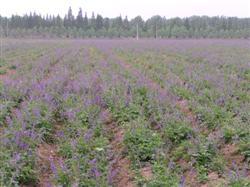
How do you grow Salvia miltiorrhiza (red sage)? A detailed introduction
For growing Salvia miltiorrhiza, you can refer to the following methods:
Land selection: If seedlings encounter high temperatures and dry weather, seedling growth stalls or even dies. Salvia miltiorrhiza has deep roots and requires deep soil layers, good drainage, and medium-fertility sandy loam as the best option. If the soil is too fertile, the roots will instead be less sturdy. Waterlogging is most taboo; cultivation in low beds with poor drainage causes root rot. Soil pH close to neutral is best. Soil that is too sandy or too clayey is not suitable for planting. Propagation by seedling transplanting: Salvia miltiorrhiza cultivation is divided into seedling transplanting, root-stock (lutu) transplanting, and root-division transplanting.
1. Seedling transplanting
I. Raising seedlings: 1. Seedbed preparation: The seedbed and seedling field are best with relatively fertile fine sandy loam. Apply 40--70 kg of compound fertilizer per mu, plow more than 20 cm deep, harrow fine and level, remove stones, and make beds. Each bed is 1--1.2 m wide, with drainage ditches left.
II. Sowing: Use about 2.5--5 kg of seeds per mu. Evenly broadcast the treated seeds onto the seedbed in a timely manner, and gently pat
the ground surface with a large broom or iron shovel, then cover with wheat straw to preserve moisture, keep warm, and provide shade, and immediately water the wheat straw thoroughly to soak the soil, and pay attention to maintaining moisture. When the seedlings emerge and turn green, at about 2 leaves, promptly remove the wheat straw to prevent damaging the seedlings.
III. Strengthening seedlings: If soil fertility is poor, after emergence when the seedlings grow to 4-5 leaves, apply a topdressing once combined with watering, using 10 kg of urea per mu.
1. Transplanting Field preparation: Choose a suitable field, apply 20---50 kg of compound fertilizer per mu as base fertilizer, plow more than 35 cm deep, level, open furrows, and make beds 1 m wide. Transplanting: Divided into winter planting and spring planting, with winter planting giving higher yield. Winter planting is carried out from late October to early November, between Cold Dew and Frost's Descent. When planting, use a row spacing of 20x25 cm, dig holes or open furrows, with the depth of the furrow or hole just enough for the seedling roots to extend straight, and earth up until the heart bud is slightly exposed. Plant about 10,000 plants per mu. When planting, water an appropriate amount of settling water depending on soil moisture. But absolutely avoid flooding irrigation.
2. Root-stock (lutu) propagation (1) Field preparation is the same as for seedling transplanting. (2) Planting root stocks: Root-stock propagation cultivation method: When digging Salvia miltiorrhiza, select robust plants free of pests and diseases, cut off the thick main roots for medicinal use, and use the fine roots with a diameter below 0.6 cm together with the root stocks on the rhizome as planting material. Dig holes or open furrows at a row spacing of 25x20 cm, with the furrow depth just enough for the fine roots to extend naturally, then plant the root stocks into the holes or furrows, cover with soil and press firm, slightly exposing the heart bud.
3. Root-cutting propagation, also called root-division cultivation. Select and keep robust plants free of pests and diseases in place without digging them up, to keep as seed roots, and plant them as they are dug at planting time. Winter planting is from late October to mid-November, and spring planting is in early spring in March. On the leveled and finely harrowed planting beds, open furrows or dig holes at a row spacing of 20x25 cm, with a hole or furrow depth of 5--7 cm. Cut the seed roots into small sections of 5--7 cm as seed roots, with the thick end facing up, and plant 1 section per hole. After planting, cover with burnt soil ash, then cover with fine soil about thick. Note that they absolutely must not be planted upside down, otherwise they will not sprout. About 80 kg of seed roots are needed per mu, then cover with plastic film, and after emergence punch holes to release the seedlings. Around Qingming, when the ground temperature rises, remove the plastic film.
IV. Field management
1. Intertillage and weeding. Generally carry out intertillage and weeding 3 times: once in April when seedlings are about 2-4 cun tall; once around early June before and after flowering; and once in late August. These last two times can use loosening the soil and hoeing weeds. Normally, remove weeds whenever they appear. For large-scale planting, use herbicides and plastic film to control weeds.
2. Topdressing combined with intertillage and weeding 3 times. The first time, apply about 10 kg of nitrogen fertilizer per mu to promote seedling growth. The second time, use about 10 kg of compound fertilizer. If seeds are to be harvested, apply about 10 kg of potassium fertilizer to help the seeds become plump; the third time, apply an appropriate amount of phosphorus fertilizer and potassium fertilizer per mu to promote strong and vigorous growth of the Salvia miltiorrhiza roots.
3. Irrigation and drainage. In Salvia miltiorrhiza fields, accumulated water is most taboo, as accumulated water easily causes root rot. In dry weather, promptly use furrow soaking irrigation; where conditions allow, automatic sprinkler irrigation can be used, and accumulated water should be drained promptly to avoid waterlogging and root rot.
4. Bud removal and growth control. If Salvia miltiorrhiza seeds are not to be kept, it is recommended to remove the flower buds, which can increase yield by about 30%.
[Pest and disease control]
1. Leaf spot disease harms the leaves. Dark brown lesions often appear on diseased parts, nearly round or irregular in shape, later gradually merging into large spots, and in severe cases the leaves wither and die. It occurs in early May, and the disease is severe from June to July.
Control methods: (1) Strengthen field management and implement crop rotation; (2) Increase application of phosphorus and potassium fertilizers, or spray 0.3% potassium dihydrogen phosphate on the leaf surface to improve disease resistance of Salvia miltiorrhiza. At the early stage of disease, spray carbendazim, thiophanate-methyl, or zineb for control. When the disease is severe, spray 50% carbendazim 500-1000 times dilution, or 70% thiophanate-methyl 800 times dilution, once every 7-10 days, for 2-3 consecutive times.
2. Root rot occurs from May to November. In the early stage, individual branch roots or fibrous roots turn brown and rot, then gradually spread to the main root, causing the entire root to rot, with the outside turning black, and finally the plant dies.
Control methods: (1) After rain, promptly dredge ditches and drain water; (2) Before planting, soak seed roots with 25% carbendazim 200 times dilution for 10 minutes, dry them, then plant; (3) During the disease period, drench diseased plants with 50% carbendazim 800-1000 times dilution, or 50% thiophanate-methyl 1000 times dilution.
3. Salvia miltiorrhiza root-knot nematode disease. Due to parasitism by root-knot nematodes, many tumor-like growths develop on the roots, causing the plant to grow short and stunted, develop slowly, and the leaves to fade green and gradually turn yellow, and finally the whole plant withers and dies. When a diseased plant is pulled up, there are many insect gall-like tumors on the fibrous roots. Prick one open with a needle, and small white dots visible to the naked eye are the female nematodes.
Control methods: (1) Rotate with cereal crops; (2) Combined with land preparation, apply 3% methyl isothiophos 5 kg per mu, scatter it on the ground, and turn it into the soil for soil disinfection.
4. Silver-marked noctuid moth. Its larvae feed on Salvia miltiorrhiza leaves, biting them into holes or notches, and in severe cases can eat the leaves completely. This insect occurs 5 generations per year. The second-generation larvae begin harming Salvia miltiorrhiza in June-July, with the most severe damage from late July to mid-August, so control should be carried out early.
Control methods: (1) After harvest, collect and burn residual diseased leaves in the field to kill overwintering insect populations; (2) Hang blacklight lamps in the cultivation area at night to trap and kill adult moths; (3) When they occur, spray pesticide 10% fenvalerate 2000-3000 times dilution; or 40% omethoate 1000 times dilution; or 90% trichlorfon 1000 times dilution, etc., to kill them.
5. Other pests include mole crickets, cutworms, etc., controlled by conventional methods.
[Harvesting and processing]
1. Harvesting. For those propagated asexually and those transplanted, dig them in November of the same year after planting or before sprouting in spring of the second year. Because the roots go deep into the soil and are brittle and easily broken, choose a sunny day and dig carefully when the soil is half-dry and half-moist. First loosen the soil around the roots, then dig out the roots completely along the rows. After digging, sun-dry them in the field, remove soil, and transport them back for processing. Do not wash with water.
2. Processing. Dry the roots in the sun until about 50% dry. After the texture becomes soft, press them straight by hand, tie them into bundles, and pile them for 2-3 days to sweat. Then spread them out again to dry until completely dry, remove fibrous roots and trim the root stock, and cut off the fine tail ends to make the commercial product.
[Yield and quality]
1. Yield. Generally, the dry yield is 300-400 kg per mu, and can reach 500-600 kg at high yield. The conversion rate is 30%.
2. Quality. Qualified products are those with no root stock, fibrous roots, sand or impurities, mold, and no broken sections less than 7 cm long; those with thick, sturdy roots and purple-red outer skin are considered superior.
Click to get more Salvia miltiorrhiza cultivation techniques
Click to get more medicinal herb cultivation techniques