What are the harmful symptoms of cucumber anthracnose?
What harm does cucumber anthracnose cause? What methods can prevent and control cucumber anthracnose? We also ask fellow gardeners to share their guidance. The harm and control methods of cucumber anthracnose can refer to the following introduction: Harm of cucumber anthracnose: Anthracnose can occur at the seedling stage and on mature plants. When it occurs at the cotyledon stage, yellow-brown semicircular lesions appear on the edges of the cotyledons...
 What harm does cucumber anthracnose cause? What methods can prevent and control cucumber anthracnose? We also ask fellow gardeners to share their guidance.
The harm and control methods of cucumber anthracnose can refer to the following introduction:
Harm of cucumber anthracnose:
Anthracnose can occur at the seedling stage and on mature plants. When it occurs at the cotyledon stage, yellow-brown semicircular lesions appear on the edges of the cotyledons, slightly sunken.
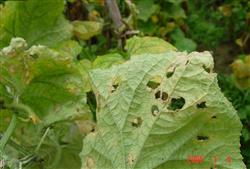
When mature plants are affected, water-soaked lesions appear on the leaves and gradually expand into nearly round brown spots with a yellow halo ring on the outer edge. Typical lesions are 10-15 mm. When there are many lesions, they merge into irregular patches. Under high humidity, orange-red sticky material grows on the lesions. When dry, the center of the lesions sometimes shows star-shaped cracking or falls out to form holes, and the leaves may even dry up and die. Lesions on petioles or stems are often sunken, sometimes with small pink dots on the surface. The lesions change from pale yellow to brown or gray. If a lesion spreads around the entire stem, the stem and vine die.
When the fruit is infected in the early stage, pale green water-soaked spots appear, quickly turning dark brown, continuously enlarging and becoming sunken, with a darker center and many small black dots on the upper part. Under high humidity, the lesions become frog-flesh-like. Later, pink sticky material appears on the surface of the lesions, which often crack, and the diseased fruit becomes curved and deformed.
Causes of cucumber anthracnose:
Anthracnose is a fungal disease caused by Colletotrichum fungi. The suitable temperature range for the disease is wide, and it can occur at 10-30°C. The pathogen stops growing below 8°C and above 30°C, and 24°C is most suitable for pathogen growth. The disease is severe under high humidity, especially above 95%, when it develops rapidly. When humidity is less than 54%, the disease does not occur.
The anthracnose pathogen can overwinter in the soil with diseased plant residues. The pathogen can also attach to the seed surface, and field trellises and facilities can also carry the pathogen. These are all primary infection sources for the disease in the following year. The disease occurs more often in humid protected cultivation and in rainy seasons in open fields, and in some areas it has risen to become a major disease.
Control methods for cucumber anthracnose:
Method 1. Seed disinfection:
Soak the seeds in warm water at 50-55°C for 15 minutes, or soak them in a 150-fold solution of 40% formaldehyde (formalin) for 1 hour, or soak them in a 500-fold solution of 50% amobam for 1 hour, or soak them in a 100-fold solution of glacial acetic acid for 30 minutes, then rinse them clean with water before promoting germination.
Method 2. Cultivation measures:
Choose anthracnose-resistant varieties, such as Jinyan No. 4, Xiafeng No. 1, Zhongnong No. 5, etc.;
When raising seedlings, pay attention to the hygiene and disinfection of the seedbed soil. Carbendazim can be used to disinfect the seedbed soil, and chlorothalonil smoke agents can be used to fumigate the greenhouse used for seedling raising as well as its farm tools and trellises, etc.;
Cultivate strong seedlings to improve the disease resistance of the seedlings; during cultivation, apply more phosphorus and potassium fertilizers and frequently carry out foliar fertilization to enhance plant resistance; promptly remove diseased leaves and diseased plants, and when changing crops, clean up all residual stubble; for plots with severe disease, carry out a 3-year crop rotation.
Method 3. Chemical control:
A 1000-fold solution of 50% captan, a 200-300-fold solution of 20% zineb, a 1000-fold solution of 70% mancozeb, an 800-fold solution of 80% anthracnose thiram, a 600-fold solution of 50% thiophanate-methyl wettable powder, a 700-fold solution of 75% chlorothalonil, a 1500-fold solution of 50% benomyl powder, a 500-fold solution of 50% carbendazim powder, or a 300-fold solution of Shuangxiaoling can be used, sprayed once every 7-10 days for 3-4 consecutive sprays. The various chemicals can be used in rotation.
A 200-fold solution of 2% Nongkang 120 aqueous solution, or a 150-200-fold solution of 2% Wuyimycin (BD-10) can also be sprayed for biological control.
Method 4. Daily control:
In protected facilities, dusting with 5% chlorothalonil dust, 5% kemeling dust, or 12% ketanling dust can be used for dust control, with better results; 45% chlorothalonil smoke agents can also be used for fumigation.
Click to get more cucumber cultivation techniques
Click to get more vegetable growing techniques