How should Angelica dahurica be managed to achieve high yields?
How can Angelica dahurica be managed to achieve high yields? Please give some guidance. To achieve high yields when growing Angelica dahurica, you must pay attention to management. The following management methods for Angelica dahurica are for reference: 1. Thinning and final thinning of seedlings: Angelica dahurica seedlings grow slowly, so generally no thinning is done in the year of sowing. After the seedlings turn green again in early spring of the second year, when the seedlings are about 5-7 cm tall, carry out the first thinning, removing...
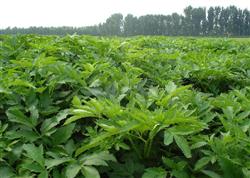
How can Angelica dahurica be managed to achieve high yields? Please give some guidance
To achieve high yields when growing Angelica dahurica, you must pay attention to management. The following management methods for Angelica dahurica are for reference:
1. Thinning and final thinning of seedlings: Angelica dahurica seedlings grow slowly, so generally no thinning is done in the year of sowing. After the seedlings turn green again in early spring of the second year, when the seedlings are about 5-7 cm tall, carry out the first thinning, removing the overly dense and weak seedlings. For drilling, leave one plant every about 5 cm; for dibbling, leave 5-8 plants per hole; for the second thinning, leave one plant every about 10 cm or leave 3-5 plants per hole. Around Qingming, when the seedlings are about 15 cm tall, carry out final thinning, with a plant spacing of 13-15 cm or leaving 3 plants per hole, staggered in a triangle to facilitate ventilation and light penetration. During final thinning, remove the overly vigorous large seedlings with greenish-white leaf stalks to prevent early bolting and flowering.
2. Intertillage and weeding: It is best to carry them out together with thinning and final thinning. Once the leaves gradually grow larger and the bed surface is closed and shaded, there is no need to weed again.
3. Topdressing: Angelica dahurica is a relatively fertilizer-tolerant crop, but generally before spring it should be given little or no fertilizer to prevent excessive seedling growth and early bolting and flowering. After spring, vegetative growth begins to flourish, and topdressing can be done 3-4 times. The first and second times are both after thinning and intertillage, and the third and fourth times are after final thinning and before the bed surface closes. Fertilization should be done on sunny days; it is not suitable to fertilize just after rain clears or on the same day after intertillage and weeding. Fertilizer types can include human excrement and urine, decomposed cake fertilizer, barnyard manure, urea, and so on. For the first fertilization, the fertilizer should be light and small in amount, such as applying 10 loads of dilute human and livestock manure per mu, and afterward it can gradually be made stronger and larger, such as 30-40 loads. The application before the bed surface closes can be combined with phosphate and potassium fertilizers, such as 20-25 kg of superphosphate, to promote thick roots. It has been reported that in the topdressing before the bed surface closes, applying 25 kg of calcium magnesium phosphate and 5 kg of potassium chloride, followed immediately by hilling soil, can prevent lodging and promote growth.
The number of topdressings and the amount applied each time can also be determined according to the plant's growth. If, when the bed surface is about to close, the plant's leaves are light green and not very vigorous, topdress once more; or if at this time the leaves are dark green and growth is vigorous, topdressing can be omitted.
4. Drainage and irrigation
Angelica dahurica likes water but fears waterlogging. After sowing, if the soil is dry, water immediately; afterward, if there is no rainy weather, water once every few days to keep the bed surface moist before the seedlings emerge, as this helps seedling emergence; during the seedling stage, the soil should also be kept moist to prevent yellow leaves and the formation of too many lateral roots; before the seedlings overwinter, water thoroughly once. Henan has the experience that "wet freezing is best, dry freezing does not easily survive," and Hebei has the experience that "in winter, Angelica dahurica only dies from dryness, not from freezing." After spring of the following year, irrigation can be done at the right time together with topdressing, especially during the dog days, when sufficient moisture should be maintained. If in the rainy season there is standing water in the field, open ditches promptly to drain it, to prevent root rot and disease from waterlogging.
5. Pulling out bolting seedlings
In May of the second year after sowing, some plants will bolt and flower. Their roots cannot be used as medicine, and the seeds they produce cannot be used as seed, because the next generation will bolt early. Therefore, in order to reduce the consumption of nutrients in the field, bolting plants should be pulled out promptly when found.
Click to get more Angelica dahurica cultivation techniques
Click to get more medicinal herb cultivation techniques