What are the control methods for pepper anthracnose?
How do you control pepper anthracnose? What is pepper anthracnose like? Please give an introduction. Pepper anthracnose damage: anthracnose invariably harms pepper fruits and old leaves, and can also infect the stems. 1. When fruits are infected, water-soaked yellowish-brown round spots first appear, and after they expand the edges turn brown and the centers grayish-brown, and the lesions have raised concentric rings formed by many small black or orange-red dots.
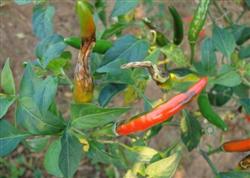 How do you control pepper anthracnose? What is pepper anthracnose like? Please give an introduction
Pepper anthracnose damage:
Anthracnose invariably harms pepper fruits and old leaves, and can also infect the stems.
1. When fruits are infected, water-soaked yellowish-brown round spots first appear, and after they expand the edges turn brown and the centers grayish-brown, and the lesions have raised concentric rings formed by many small black or orange-red dots.
2. In humid conditions, a red sticky substance oozes from the surface of the lesions, and the affected fruit becomes semi-soft and rots, and tends to shrivel. When leaves are infected, nearly round brown spots appear with grayish-brown centers, and later black small grains arranged in rings form; in severe cases this leads to defoliation.
3. When stems and fruit stalks are infected, irregular short strip-shaped sunken brown spots appear, and the epidermis tends to split when dry.
Causes of pepper anthracnose:
Anthracnose is caused by fungal infection. The pathogen overwinters as conidia attached to the seed surface or as mycelium latent inside the seed, and sowing infected seeds causes seedling disease. The pathogen can also overwinter as mycelium or acervuli with diseased plant debris in the soil, becoming the primary infection source for the next season. After overwintering, the conidia that grow out germinate and produce germ tubes, which invade through wounds in the host epidermis, and after disease develops a large number of conidia are produced for secondary infection. High temperature and high humidity favor disease development, and low-lying fields, heavy clay soil, poor permeability, insufficient fertilization or excessive nitrogen fertilizer, rough management that causes wounds, and fruits exposed to strong sunlight all aggravate the disease.
Control methods for pepper anthracnose:
1. Turn and sun the soil before sowing to reduce the primary infection source.
2. Use disease-free seeds, and soak the seeds in hot water at 50°C for 20 minutes.
3. Plant at a reasonable density so that after the pepper plants close their rows the space between rows is not shaded and the fruits are not exposed.
4. Appropriately increase the application of phosphorus and potassium fertilizers.
5. Prevent waterlogging in the field.
6. Harvest fruits in good time.
7. As soon as diseased fruits are found, pick them off and carry them out of the field for destruction.
8. In heavily diseased fields, rotate with cucurbit and legume vegetables for 2 to 3 years.
9. In the early stage of disease, spray for control with a 500-fold dilution of 50% carbendazim wettable powder or 70% mancozeb wettable powder. For protected cultivation, fumigate with 250 g of 45% chlorothalonil smoke agent per mu.
Click to get more pepper growing techniques
Click to get more vegetable growing techniques