What causes anthracnose in peppers?
What causes pepper anthracnose? Here is a detailed introduction. Pepper anthracnose, also called pepper continuous cropping disease, is a major disease of peppers, widely distributed and severely damaging. Under high temperature and high humidity conditions, it spreads rapidly, causes damage for a long time, causes severe damage, and results in large losses. Pepper anthracnose can occur from the seedbed stage to after transplanting...
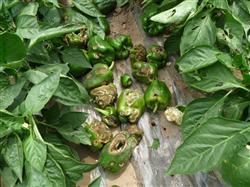 What causes pepper anthracnose? Here is a detailed introduction
Pepper anthracnose, also called pepper continuous cropping disease, is a major disease of peppers, widely distributed and severely damaging. Under high temperature and high humidity conditions, it spreads rapidly, causes damage for a long time, causes severe damage, and results in large losses.
Pepper anthracnose can occur from the seedbed stage to after transplanting, mainly damaging leaves and fruits, with mature fruits and old leaves being especially susceptible.
When leaves are affected, the leaf margins show water-soaked brown spots, nearly round with a light gray center, bearing whorled black dots, which are the pathogen's acervuli.
When fruit stalks are affected, brown irregular sunken spots appear, which tend to crack when dry.
Plants have poor disease resistance during the maturity stage. Under rainy or high temperature conditions, fruits are easily affected, with brown, water-soaked round or irregular lesions bearing many whorled black dots, surrounded by a moist discolored halo. After fruits are affected, they tend to shrivel, and the lesions become membranous, like parchment paper, and easily rupture.
Causes of pepper anthracnose
Poor varieties: linear peppers have weaker disease resistance than sweet peppers. In recent years, variety mixing and degeneration have also been important causes of disease outbreaks.
Continuous cropping: with years of continuous planting, pathogens accumulate quickly and reach high levels. Once conditions are suitable, the disease spreads and expands rapidly.
Diseased leaves, diseased fruits, and plant residues are not thoroughly removed. The pathogen continuously spreads outward through wind and rain. Even in a new crop, as long as the pathogen is present and conditions are suitable, it can cause disease outbreaks and epidemics.
Seedbed management is unscientific, meaning no chemical disinfection treatment of seeds and no soil sterilization are carried out. Under high temperature and high humidity conditions, the seedbed becomes infected, and after transplanting to the field, the disease can continue to cause damage.
The pathogen invades through wounds, and after onset, it spreads and causes damage through wind and rain, airflow, and piercing-sucking pests such as aphids and leafhoppers.
Onset conditions: the pathogen's development temperature is 12-32°C, the optimum temperature is 27°C, and the relative humidity is about 95%. An early rainy season with suitable temperature and humidity is also an important cause of disease occurrence and epidemic spread.
There are many repeated infections. Under suitable temperature conditions and relative humidity of 87%-95%, the pathogen's incubation period is only about 3 days, infection occurs frequently, pathogens accumulate quickly, and a major epidemic can occur within a short period.
Summer drought, sustained high temperatures, and severe sunscald favor the epidemic of the disease in the later stage.
High planting density, excessive application of nitrogen fertilizer, poor drainage, and poor ventilation and light penetration can accelerate the epidemic of the disease.
Medication is not timely. Neglecting chemical control in the seedbed and field, and failing to achieve early detection and early treatment and to prevent trouble before it happens.
Click to get more pepper growing techniques
Click to get more vegetable growing techniques