Key Management Techniques for Summer Corn During the Flowering and Grain-Filling Stage
How should summer corn be managed during the flowering and grain-filling stage? Please introduce the following methods that can be used for managing summer corn during the flowering and grain-filling stage: First, apply grain fertilizer judiciously: the so-called judicious application should be determined by the appearance of the plants in the field. In fields where the ear fertilizer is sufficient, the plants look good, the leaf color is dark green, and there is no sign of premature decline or fading, it may be omitted to avoid prolonging the growth period. If the ear fertilizer is insufficient and the plants show signs of nutrient deficiency, then grain fertilizer should be supplemented. The principle for applying grain fertilizer is "early rather than late." Generally, apply 5 kg of urea or 10-15 kg of ammonium bicarbonate per mu, by hole application at depth. A mixture of 1%-2% urea and 0.4%-0.5% potassium dihydrogen phosphate can also be used for foliar spraying, using 70-100 kg of solution per mu.
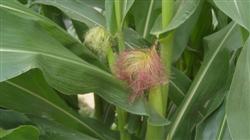
How should summer corn be managed during the flowering and grain-filling stage? Please introduce
Summer corn can be managed during the flowering and grain-filling stage by referring to the following methods:
First, apply grain fertilizer judiciously: the so-called judicious application should be determined by the appearance of the plants in the field. In fields where the ear fertilizer is sufficient, the plants look good, the leaf color is dark green, and there is no sign of premature decline or fading, it may be omitted to avoid prolonging the growth period. If the ear fertilizer is insufficient and the plants show signs of nutrient deficiency, then grain fertilizer should be supplemented. The principle for applying grain fertilizer is "early rather than late." Generally, apply 5 kg of urea or 10-15 kg of ammonium bicarbonate per mu, by hole application at depth. A mixture of 1%-2% urea and 0.4%-0.5% potassium dihydrogen phosphate can also be used for foliar spraying, using 70-100 kg of solution per mu.
Second, irrigation and drainage: soil moisture should be maintained at 70%-80% of the field maximum water-holding capacity, which is favorable for flowering and fertilization. If there is drought, irrigate promptly; if the field water-holding capacity exceeds 80%, pay attention to drainage.
Third, detasseling in alternate rows: when corn has just tasseled, remove the tassels of every other row or every other plant, detasseling half of the field, which helps ventilation and light penetration in the field, saves nutrients, reduces insect damage, and can increase yield by 5%-8%. The detasseling method is: when the tassel has emerged 1/3 or 1/2 from the top leaf, before pollen shedding, promptly remove the tassel of every other row or every other plant. It is best to remove the male flowers of plants that tassel first or of weak plants and insect-damaged plants, but do not detassel the few rows at the field edge, so as not to affect pollination. When detasseling, never damage the top leaves, and even more, do not cut off the stems and leaves above the ear, otherwise yield will be reduced.
Click to get more corn planting techniques
Click to get more food crop planting techniques