Spinach Downy Mildew: Control Methods and Key Cultivation Techniques
How do you control spinach downy mildew? Here we explain the causes of the disease and control methods. Spinach downy mildew mainly affects the leaves. When leaves are infected, small irregular pale yellow spots appear first; after they expand, the lesions join together, and in severe cases the leaves turn yellow and wither. When conditions are humid, the diseased leaves rot, and on the underside of infected leaves a grayish-purple mold grows...
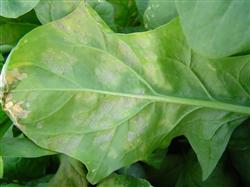 How do you control spinach downy mildew? Here we explain the causes of the disease and control methods
Spinach downy mildew mainly affects the leaves. When leaves are infected, small irregular pale yellow spots appear first; after they expand, the lesions join together, and in severe cases the leaves turn yellow and wither. When conditions are humid, the diseased leaves rot, and on the underside of infected leaves a grayish-purple mold layer grows, namely the sporangia and sporangiophores.
Spinach downy mildew mainly occurs on autumn-sown spinach or on overwintering spinach plants, where it overwinters as oospores inside diseased leaves, becoming the primary infection source for the following year. Under suitable conditions, sporangia are produced and spread by air currents; they produce germ tubes and invade through the stomata and epidermis of the leaves, and after infection sporangia are produced in the diseased parts for secondary infection. Under low temperature and high humidity conditions, the disease is generally severe.
Control methods for spinach downy mildew:
1. In heavily infected fields, implement a 2-3 year crop rotation. Apply sufficient well-rotted organic fertilizer to improve the plants' disease resistance. Plant at a reasonable density, water scientifically, avoid flood irrigation, strengthen ventilation, and reduce humidity. Keep the field clean; when diseased leaves or shrunken plants are found, pull them out promptly. At harvest, thoroughly remove residual plants and fallen leaves, and carry them out of the field for deep burial or burning.
2. In the early stage of the disease, spray 90% Yishuangling wettable powder at 500 times dilution, or 70% Yimeng wettable powder at 400 times dilution, or 72% Kemeixing wettable powder at 500 times dilution, or 72% Kelu wettable powder at 600-800 times dilution, or 72% Kekangling wettable powder at 600-800 times dilution, or 50% Anke wettable powder at 1500 times dilution, or 58% metalaxyl-mancozeb wettable powder at 500 times dilution, or 72.2% propamocarb (Previcur) aqueous solution at 600-800 times dilution, spraying once every 7 days for 2-3 consecutive sprays. Pesticides should be applied alternately to prevent the development of resistance.
Click to get more spinach cultivation techniques
Click to get more vegetable cultivation techniques