What are the precautions for planting autumn mung beans?
What should be noted when planting autumn mung beans? Please give an introduction. The following points should be noted when planting autumn mung beans: 1. Choose a good variety. For autumn mung beans, it is advisable to choose varieties with a short growth period, high yield and good quality, with the maturity period controlled within 90 days. "Elu No. 1" and "Elu No. 3" can be selected. 2. Sow early at the right time. Autumn mung beans can be planted...
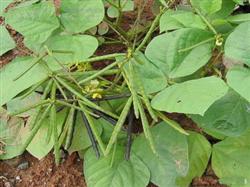
What should be noted when planting autumn mung beans? Please give an introduction
The following points should be noted when planting autumn mung beans:
1. Choose a good variety. For autumn mung beans, it is advisable to choose varieties with a short growth period, high yield and good quality, with the maturity period controlled within 90 days. "Elu No. 1" and "Elu No. 3" can be selected.
2. Sow early at the right time. Autumn mung beans can be planted around the Beginning of Autumn, but the earlier the sowing, the longer the flowering and pod-setting time and the higher the yield. After the water recedes and the field is cleared, the land should be prepared in time and sowing should be done early.
3. Reasonable close planting. Mung beans are shade-tolerant and can be intercropped with autumn corn. When planted alone, drilling or dibbling is advisable. The plant-to-row spacing is 15-17 cm x 40-50 cm, with 1.5-2 kg sown per mu, and a density of 8,000-10,000 plants. Thin and finalize the seedlings early after emergence.
4. Apply more fertilizer. Although mung beans are a legume crop, striving for a high yield of autumn mung beans still requires more fertilizer, and special attention should be paid to topdressing from emergence to the flowering stage to promote nodule formation. Generally, 20 kg of phosphate fertilizer and 12.5 kg of potassium fertilizer are applied per mu as base fertilizer, and 2.5 kg of urea as seed fertilizer. During the seedling stage and early flowering stage, promote or control growth according to the seedlings, and do a good job of foliar spraying during the flowering and podding stage.
5. Pay attention to weed infestation. Weed infestation in mung bean fields is usually relatively serious, so field weeds must be removed in time in combination with intertillage and weeding.
6. Prevent pests and diseases well. Mung beans are more seriously harmed by leaf spot disease, bean pod borer and aphids. For leaf spot disease, 3% leafhopper powder can be sprayed at 1.5-2 kg per mu, or 20-25 ml of 25% decis emulsion, or 250 g of 25% bisultap mixed with 50 kg of water can be sprayed. For bean pod borer, a 6000-fold decis solution or a 1000-fold fenitrothion solution can be used for control during the flowering and podding stage. For aphids, a 1500-fold solution of 40% dimethoate emulsifiable concentrate can be used for control.
7. Harvest at the right time. Mung bean pods easily burst and drop seeds, so they should be harvested in batches as they mature to reduce losses.
Click to get more mung bean planting techniques
Click to get more food crop planting techniques