What is the anise swallowtail butterfly in coriander cultivation?
What is the coriander anise swallowtail butterfly? How to control the coriander anise swallowtail butterfly? The harm of the coriander anise swallowtail butterfly: the anise swallowtail butterfly, also called the yellow swallowtail or golden swallowtail, mainly harms umbelliferous vegetables such as fennel, carrot and coriander. Its larvae feed on the leaves, are active and feed at night, and when touched can extend an osmeterium from the thorax and secrete...
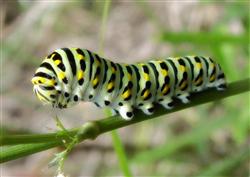 What is the coriander anise swallowtail butterfly? How to control the coriander anise swallowtail butterfly?
The harm of the coriander anise swallowtail butterfly:
The anise swallowtail butterfly, also called the yellow swallowtail or golden swallowtail, mainly harms umbelliferous vegetables such as fennel, carrot and coriander. Its larvae feed on the leaves, are active and feed at night, and when touched can extend an osmeterium from the thorax and secrete a foul liquid. The adult anise swallowtail butterfly has a yellow body, with a body length of 24-32 mm, and a black broad longitudinal stripe along the dorsal ridge; the forewings and hindwings have black and yellow markings, the hindwings have blue markings near the outer margin, and there is a red spot near the posterior margin. The egg is spherical. The mature larva has a body length of 52-55 mm, is green, has black longitudinal stripes on the head, and has short black transverse markings on the back of each thoracic and abdominal segment. The pupa is yellowish brown, striped, with 2 horn-like protrusions on the head.
The anise swallowtail butterfly has 2 generations each year, overwintering as pupae on thickets and tree branches, and emerges in April-May of the following spring. The first-generation larvae occur in May-June, and the adults emerge in June-July; the second-generation adults occur in July-August. Eggs are laid singly on the leaf surface. The larvae are active and feed at night, and when touched extend the osmeterium from the prothorax and secrete a foul liquid.
Control methods for the anise swallowtail butterfly:
1. Combine with field management to manually capture and kill the larvae.
2. Before the third instar, spray 20% Tianda diflubenzuron suspension concentrate at 1000 times dilution, 20% tebufenozide suspension concentrate at 1500 times dilution, 10% chlorfenapyr suspension concentrate at 1500 times dilution, 5% Cascade dispersible liquid at 1500 times dilution, 10% high-efficiency miebaike emulsifiable concentrate at 1500 times dilution, 98% cartap soluble powder at 1000-1500 times dilution, 4.5% Yunda Anzhi at 1500 times dilution, 90% methomyl soluble powder at 4000 times dilution, 5% fipronil emulsifiable concentrate at 2500 times dilution, 20% fenvalerate emulsifiable concentrate at 2000 times dilution, 2.5% deltamethrin emulsifiable concentrate at 2000 times dilution, 5% chlorfluazuron emulsifiable concentrate at 3500 times dilution, 2.5% beta-cypermethrin emulsifiable concentrate at 2000 times dilution, 50% phoxim emulsifiable concentrate at 1500 times dilution, etc.
Click to get more coriander cultivation techniques
Click to get more vegetable cultivation techniques