Peanut Cultivation Techniques: An Analysis of Peanut's Fertilizer Absorption Characteristics
How does the peanut absorb fertilizers? Please explain. Peanut kernels are rich in protein and fat, and forming these substances requires large amounts of nutrients. According to research, producing every 100 kg of peanut pods requires 6.8 kg of pure nitrogen (N), 1.3 kg of phosphorus (P2O5), and 3.8 kg of potassium (K2O). Nitrogen is needed the most, followed by potassium, and phosphorus the least...
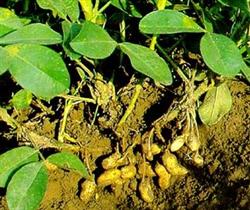
How does the peanut absorb fertilizers? Please explain
Peanut kernels are rich in protein and fat, and forming these substances requires large amounts of nutrients. According to research, producing every 100 kg of peanut pods requires 6.8 kg of pure nitrogen (N), 1.3 kg of phosphorus (P2O5), and 3.8 kg of potassium (K2O). Nitrogen is needed the most, followed by potassium, and phosphorus the least. In addition, peanuts also need a relatively large amount of calcium.
Like soybeans, peanuts form root nodules that can fix nitrogen from the air. Throughout the entire growth period, they only need to absorb 1/3 of the total nitrogen from the soil to meet their needs, while other nutrients must be absorbed from the soil. Because peanuts flower above ground and form pods underground, not only the root system absorbs fertilizers, but the pegs and young pods can also absorb fertilizers.
In general, the fertilizer absorption characteristics of peanuts are "more in the middle and less at both ends." During the seedling stage, growth is slow and nutrient absorption is low, with nitrogen, phosphorus, and potassium uptake accounting for only about 5% of the total uptake over the entire growth period. The flowering stage is a period of rapid plant growth, during which large numbers of flowers form and pegs penetrate the soil, creating a high demand for nutrients. For early-maturing varieties, nitrogen, phosphorus, and potassium uptake reaches its maximum at this stage, accounting for more than half of the total uptake. For late-maturing varieties, potassium uptake during the flowering stage approaches half of the total, while nitrogen and phosphorus uptake reaches its maximum during the pod-setting stage, accounting for more than half. During the maturity stage, the root system's absorption capacity weakens and nutrient uptake decreases.
Click to get more peanut cultivation techniques
Click to get more food crop cultivation techniques