How to Apply Jointing Fertilizer to Summer Corn? Fertilization Methods and Key Points Explained
How to apply jointing fertilizer to summer corn? When is the best time to apply jointing fertilizer for good results? Please provide guidance. Summer corn generally reaches the jointing stage 18 to 21 days after emergence. The signs of entering the jointing stage, from the external morphology, are as follows: for early-maturing varieties, such as Ludan 50, Yedan 20 and Denghai 9 corn, 4 to 5 leaves are unfolded and 7 to 10 leaves are visible;...
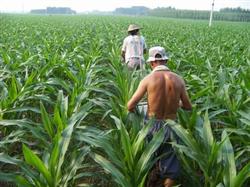
How to apply jointing fertilizer to summer corn? When is the best time to apply jointing fertilizer for good results? Please provide guidance
Summer corn generally reaches the jointing stage 18 to 21 days after emergence. The signs of entering the jointing stage, from the external morphology, are as follows: for early-maturing varieties, such as Ludan 50, Yedan 20 and Denghai 9 corn, 4 to 5 leaves are unfolded and 7 to 10 leaves are visible; for medium-maturing varieties, such as Yedan 22, Ludan 98 and Nongda 108, 6 to 7 leaves are unfolded and 9 to 12 leaves are visible; for late-maturing varieties, such as Denghai 11, Yedan 11 and Yedan 13, 8 to 9 leaves are unfolded and 10 to 13 leaves are visible. This is the best period for applying jointing fertilizer as a top dressing. After corn enters the jointing stage, stem and leaf growth becomes vigorous, the tassel begins to differentiate, and the demand for nutrients becomes increasingly urgent. Applying jointing fertilizer in time can build a good framework for later high yield. So how much fertilizer should be applied per mu as a top dressing?
Experiments show that for plots with low soil fertility, little base fertilizer, a small population, weak seedling growth, and a yield of 250 to 300 kg per mu, the top dressing amount should be 45% to 50% of the total top dressing amount; for plots with medium fertility, relatively good soil fertility, robust seedling growth, high uniformity of the field population, dark green leaves, and a yield of 550 to 650 kg per mu, in order to avoid excessive vegetative growth of seedlings and ensure steady plant growth, the jointing fertilizer can be controlled at 30% to 35% of the total top dressing amount; the remaining fertilizer should be reserved for application at the ear stage to meet the needs of the rapidly expanding vegetative body and the continuous differentiation of male and female ears. For high-yield plots with high soil fertility, sufficient base fertilizer, a large population, robust seedling growth, and a yield of 650 to 750 kg per mu, in order to prevent excessive vegetative growth, ensure steady seedling growth, maintain the balance of plant energy conversion and material metabolism, and ease the competition between the population and individuals for living conditions, top dressing at this stage should not be too much. The jointing fertilizer is generally best at 20% to 25% of the total top dressing amount; the remaining fertilizer should be reserved for application at the ear stage and grain stage, which helps promote large ears, increase grain weight and achieve high yield. When applying top dressing, deep trenches should be opened and soil should be firmly covered; never broadcast it on the soil surface. Experiments show that trench application at 5CM increased yield by 10.36% to 12.37% compared with direct broadcasting on the soil surface, and trench application at 10CM increased yield by 12.58% to 16.35% compared with trench application at 5CM. Therefore, when applying top dressing, deep application is better, in order to improve fertilizer use efficiency and cultivate strong seedlings.
Click to get more corn planting techniques
Click to get more food crop planting techniques