How should ginseng and American ginseng be fertilized when grown?
How should ginseng (American ginseng) be fertilized when grown? Please give an introduction. Ginseng and American ginseng are perennial herbaceous perennials with strict fertilizer requirements. Research by experts has found that they are potassium-loving plants, and their potassium uptake is far greater than that of nitrogen and phosphorus, meaning potassium is an important factor determining whether ginseng achieves high yields. Moreover, as the growing years increase...
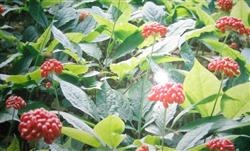
How should ginseng (American ginseng) be fertilized when grown? Please give an introduction
Ginseng and American ginseng are perennial herbaceous perennials with strict fertilizer requirements. Research by experts has found that they are potassium-loving plants, and their potassium uptake is far greater than that of nitrogen and phosphorus, meaning potassium is an important factor determining whether ginseng achieves high yields. Moreover, as the growing years increase, 4-5 year old ginseng has the highest nutrient requirement.
Nitrogen promotes the formation of chlorophyll and the growth of stems and leaves, making ginseng grow robustly; phosphorus promotes root development, plumps the seeds, and enhances cold, drought and saline-alkali resistance; potassium topdressing increases photosynthesis, strengthens the stems, promotes root development, delays senescence, and improves yield and quality. However, the ratio must be reasonable when applying them.
The approximate nitrogen-phosphorus-potassium ratio required by ginseng is 2:0.5:3. In this ratio, the sources of nitrogen, phosphorus and potassium include available nutrients and the available nutrients we need to apply. Testing shows that the soil fertilizer supply characteristics of the main ginseng-producing areas are: high total nitrogen and alkaline hydrolyzable nitrogen content, relatively high total phosphorus content, but a lack of available phosphorus, and medium or insufficient available potassium. Therefore, experts have proposed a plan to control nitrogen fertilizer and increase potassium fertilizer. Since phosphorus is easily fixed in the soil, the application rate of phosphorus must be increased, which is why the phosphorus content among the three elements is far greater than that of nitrogen. A three-element fertilizer with an N-P-K ratio of 10-23-12 and high phosphorus and potassium content can exactly meet the needs of ginseng growth and development.
Recommended rational combined application of organic fertilizer and chemical fertilizer:
1. Sowing and newly planted ginseng land Apply 0.75-1.25 kg of Shierkang + 0.4-0.5 kg of three-element fertilizer per zhang.
2. 2-3 year old and 4-5 year old: Apply 0.75-1.25 kg of Shierkang + 0.4-0.5 kg of three-element fertilizer per zhang. That is, while using nitrogen, phosphorus and potassium in combination, attention should be paid to microbial fertilizer that degrades pesticide and chemical fertilizer residues, improves soil quality, and is rich in various trace elements.
3. For topdressing, use 1 jin of Shierkang ginseng fertilizer per zhang + 1 jin of three-element fertilizer per zhang; or 1 jin of diammonium per zhang or 2-5 jin of superphosphate per zhang + 0.5 jin of potassium sulfate per zhang; or 1 jin of Shierkang ginseng fertilizer per zhang + 1 jin of diammonium per zhang or 2-5 jin of superphosphate per zhang + 0.5 jin of potassium sulfate per zhang. Apply by broadcasting combined with loosening the soil and watering.
Click to get more ginseng cultivation techniques
Click to get more medicinal herb cultivation techniques