What are the common pests and diseases of honeysuckle (Japanese honeysuckle) and their control methods?
What pests and diseases need to be controlled when growing honeysuckle? Please provide an introduction and guidance on control methods. The main diseases controlled in honeysuckle cultivation are powdery mildew and leaf spot, and the main pest is aphids, etc. The control methods can refer to the following: (1) Powdery mildew. Powdery mildew is the main disease of honeysuckle, mainly harming the leaves and tender stems...
What pests and diseases need to be controlled when growing honeysuckle? Please provide an introduction and guidance on control methods
The main diseases controlled in honeysuckle cultivation are powdery mildew and leaf spot, and the main pest is aphids, etc. The control methods can refer to the following:
(1) Powdery mildew
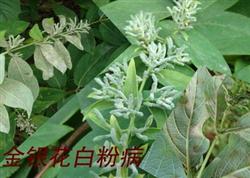
Powdery mildew is the main disease of honeysuckle, mainly harming the leaves and tender stems. The spots on the leaves are initially small white dots, then expand into white powdery patches, and later the entire leaf is covered with a white powdery layer; in severe cases the leaves turn yellow and become deformed, or even drop. It is prone to occur in warm, humid conditions or when plants are shaded. Excessive application of nitrogen fertilizer and alternating wet and dry conditions lead to severe incidence. When the disease occurs, spray 75% chlorothalonil 800x dilution, once every 7 days, for 3 to 4 consecutive sprays. Or spray 75% DuPont Equip 800-1000x dilution (for prevention) produced by the American company DuPont, or 400 g/L emulsifiable concentrate DuPont Fuxing (for infected plants) 6000-8000x dilution, which has a special effect on controlling powdery mildew. In the early stage of the disease, 50% thiophanate-methyl wettable powder or triadimefon 800-1000x dilution can be used for spraying, once every 5-7 days, for 2-3 consecutive times. Such pesticides should be prohibited during the flowering period! (2) Leaf spot
When the disease occurs, the leaves show small yellow spots, which gradually develop into small brown round spots, and finally the diseased parts dry up and perforate.
Control methods: When the disease appears, promptly remove diseased leaves to prevent spread, and spray continuously 2 to 3 times with 65% mancozeb wettable powder 400-500x dilution or 75% metalaxyl 800-1000x dilution. In the early stage of the disease, 3% jinggangmycin 50 ppm solution or 1:1.5:200 Bordeaux mixture can also be sprayed, once every 7-10 days, for 2-3 consecutive times. Strengthen cultivation management, apply more organic fertilizer, and enhance the disease resistance of the plants;
(3) Leopard moth borer
a. Symptoms: The larvae bore in from branch forks or new shoots, gnaw a ring between the xylem and phloem, and after 3-5 days the damaged new shoots wither and the branches break in the wind. After the larvae grow to 3-5 mm, insect frass is expelled from the bore holes; the frass is long cylindrical, pale yellow, and not easily broken. Generally, there are several frass-expelling holes on one side of the damaged branch. These larvae have the habit of moving to other plants to cause damage. In September-October, the affected plants show dead branches.
b. Control methods: Promptly clean up damaged branches and trunks; in mid-to-late July, during the peak hatching period of the larvae, spray 40% dimethoate emulsifiable concentrate 1500x dilution with 0.3-0.5% kerosene added.
(4) Honeysuckle hawk moth
a. Symptoms: It mainly harms leaves; when outbreaks occur, the leaves of the plants are completely eaten.
b. Control methods: Clean the field to reduce overwintering insect sources; during the young larval stage, spray 40% dimethoate emulsifiable concentrate 1000-1500x dilution.
(5) Aphids
a. Symptoms: They cause damage from Qingming to Xiaoman, become more severe after Lixia, and spread faster in wet and cloudy weather. They can cause leaves and flower buds to curl and branches to stop growing.
b. Control methods: Spray lime sulfur mixture once generally before germination, and spray dimethoate emulsion and other pesticides once each at Qingming, Guyu, and Lixia.
Click to get more honeysuckle cultivation techniques
Click to get more medicinal herb cultivation techniques