Rice pests and diseases: How do you control common rice pests and diseases?
How do you control common rice pests and diseases? Please provide an introduction and guidance on how to control the common rice pests and diseases: rice thrips, leaf roller (rice skipper), rice leaf roller, and rice planthopper. For detailed control methods, you can refer to the following methods: 1. Rice thrips. Rice thrips are very small, and the adults are dark brown, winged, and crawl...
 How do you control common rice pests and diseases? Please provide an introduction and guidance on how to control them.
The common rice pests and diseases include: rice thrips, leaf roller (rice skipper), rice leaf roller, and rice planthopper. For detailed control methods, you can refer to the following methods:
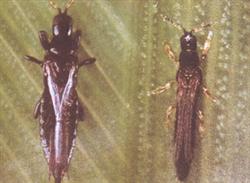
1. Rice thrips. Rice thrips are very small, and the adults are dark brown, winged, and crawl very quickly. Their life cycle has three stages: egg, nymph, and adult. The nymphs resemble the adults, are pale yellow, very small, wingless, and often curl at the tips of rice leaves, sucking the sap from the rice leaves. The damaged rice leaves lose water and curl, the rice seedlings turn yellow, the rice leaves have scattered small white spots, and the heart leaves shrivel, looking like they have been scorched by fire from a distance. During flowering, rice thrips gather
Control methods. Because rice thrips are very small, they generally do not easily attract people's attention, and they are only discovered when rice is severely damaged and a large number of leaves curl. Therefore, timely inspection is necessary to eliminate rice thrips at the larval stage. Use 1500-2000 times dilution of 40% dimethoate emulsion per mu; after applying the pesticide in both seedling fields and main fields, keep a water layer. After controlling rice thrips, apply quick-acting fertilizer to promote the recovery of seedling and tiller growth.
2. Rice planthopper. Among rice planthoppers, the brown small brown planthopper and the white-backed planthopper are the most damaging. Rice planthoppers generally hide in the leaf sheaths and stem tissues in the lower part of rice plants in the middle of the paddy field, sucking the sap from the rice stems. Irregular elongated brown spots appear on the damaged parts of the rice seedlings, and in severe cases, the base of the rice plant turns dark brown. Because the stem tissue is destroyed, nutrients cannot rise, and the rice plant gradually wilts and dies, or lodges. After rice heading, the lower rice stems age, and rice planthoppers move to the upper part to suck on the tender panicle neck, causing rice grains to become empty shells or half-filled grains. At the same time, the small brown planthopper can transmit rice viral diseases.
Control methods. 1. Oil-drip insect killing. Drip 400-500 grams of waste diesel oil or waste machine oil per mu, keep a shallow water layer of 20 cm in the field, and manually drive the insects; the insects fall into the water and die upon contact with the oil. After treatment, replace with clean water. Do not use this method after the booting stage. 2. Spread poisoned soil. Spread 1.5 kg of dimethoate powder and 2 kg of moist fine soil per mu. 3. Spray with pesticide. Spray with 0.5 kg of 40% dimethoate emulsion mixed with 800-1000 kg of water.
3. Rice skipper. The rice skipper, also called the leaf roller, often occurs once every few years, causing large reductions in rice yield. The adult is a reddish-brown butterfly, and the larvae damage rice. After the rice leaves are damaged, they become broken and fragmented, and in severe cases only the leaf veins remain, making the rice clump look like a pot-scrubbing broom. Especially after damage at the rice booting stage, the larvae spin silk to bind the rice leaves together, causing the rice panicles to curl and be unable to emerge, affecting yield.
Control methods. 1. Spray 2 kg of 2.5% trichlorfon powder per mu, or spread poisoned soil made from 1 kg of parathion-methyl and BHC powder plus 10 kg of fine soil. 2. Spray with 150 grams of 90% crystalline trichlorfon mixed with 80-100 kg of water.
4. Rice leaf roller. When the larvae are slightly larger, they begin to spin silk in the rice heart leaves, rolling both sides of the leaf into a tubular worm case. The insects hide inside the case and feed on the leaf mesophyll and upper epidermis, and after heading, they damage the tender leaf sheaths. In severe cases, only the transparent, whitish epidermis remains of the rolled leaves, and the entire leaf dies.
Control methods. Spray with 250 times dilution of 25% DDT emulsion, or 1000-1500 times dilution of 90% trichlorfon. The control timing should be before the third instar of the larvae, and applying the pesticide in the evening gives the best effect. After control, check the effect; if the insect population density is the same as before, treat once more.
Click to get more rice cultivation techniques
Click to get more grain crop cultivation techniques