What should be noted when planting kudzu?
What should be noted when planting kudzu? Please give an introduction. The following points should be noted when planting kudzu: 1. Site selection: Kudzu has strong adaptability and does not have strict requirements for soil conditions, but deep, fertile, well-drained sandy red loam is best. 2. Land preparation: For general dry land, plow and turn about 33 cm, break up and rake the soil surface...
What should be noted when planting kudzu? Please give an introduction.
The following points should be noted when planting kudzu:
1. Site selection: Kudzu has strong adaptability and does not have strict requirements for soil conditions, but deep, fertile, well-drained sandy red loam is best.
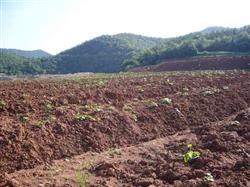
2. Land preparation: For general dry land, plow and turn about 33 cm, break up and rake the soil surface, and make high beds about 3 m wide. On the bed surface, open two rows of planting holes at a row spacing of about 1.5 m and a plant spacing of 0.65 m; 500-600 plants can be planted per 667 sq m (1 mu). For sloped land with a gradient below 25°, there are two land preparation methods: digging holes and digging trench beds. Before digging holes or trenches, the miscellaneous trees and weeds on the mountain site must be cleared, and the land fully dug and loosened to a depth of 15 cm. For hole-digging land preparation, after fully digging and loosening the soil, dig holes 60 cm square along horizontal strips 1-1.5 m wide, with about 1.5 m between holes, planting 300-500 plants per 667 sq m. For trench-bed land preparation, after fully digging and loosening the soil, dig trenches along the contour lines according to the terrain, with a width and depth of 80 cm each and a trench spacing of 1 m, generally planting 500-600 plants per 667 sq m.
3. Fertilization: Kudzu is a crop with a relatively high fertilizer demand, especially requiring more organic fertilizer and potassium fertilizer. For the base fertilizer, decomposed compost or barnyard manure can be used. For general dry land, apply 2000-3000 kg per 667 sq m, and 500 kg of plant ash can be added; for sloped land, apply 5000 kg per 667 sq m. The base fertilizer should be mixed evenly with fine soil, applied in the holes or trenches, and then covered with broken soil.
4. Planting: After the late-winter kudzu harvest, immediately select smaller tubers free from disease and insect damage as seed kudzu. In the spring of the following year, begin sprouting and raising seedlings. At the end of March and beginning of April, when the buds sprout and grow into 80-100 cm long stems and vines, they can be planted. The cuttings to be planted are required to be short and thick, taken from the middle and lower parts of the stems and vines, with 2 or more nodes. When planting, the cuttings should be inserted obliquely into the previously prepared kudzu mounds (kudzu ridges), then filled with soil and pressed firm; on cloudy or sunny days, water should be applied to settle the roots. The planting depth should be such that the kudzu nodes are buried about 1 cm below the ground and the young buds just emerge from the ground.
5. Management: After the planted seedlings reach 20 cm in height, the soil should be loosened by hoeing, and at the same time a diluted decomposed human manure and urine should be applied once slightly away from the base of the kudzu seedlings. After that, repeat the application once every 20 days for a total of 2-3 times, with the concentration and application amount increasing each time. After the tubers form and are rapidly expanding, one heavy topdressing should be applied: 1500 kg of decomposed human manure and urine per 667 sq m, plus 15 kg of potassium dihydrogen phosphate, or 30 kg of compound fertilizer applied in holes per 667 sq m. Stop topdressing 15 days before tuber harvest.
Kudzu is drought-tolerant but not waterlogging-tolerant. The principle of watering is to prefer slightly dry conditions and strictly avoid excessive moisture. Generally, water lightly after planting to promote seedling growth, and irrigate together with fertilization at ordinary times, keeping the soil moist.
If weeds grow during the seedling stage, cultivation and weeding can be carried out. The suitable cultivation depth is 4-5 cm. After the tubers form, cultivation is generally not carried out.
Kudzu has strong resistance and very few diseases. There are a small number of pests, and special attention should be paid to underground pests.
6. Harvest: In production, kudzu is mostly grown as a biennial crop. Propagation is by cuttings using sprouts sent out from the tubers. Seedlings are raised in winter and spring, planted in early spring, and harvested from October to December of the following year.
Click to get more kudzu planting techniques
Click to get more medicinal herb planting techniques