What causes the yellowing and dying leaves of garlic chives? How to prevent and control it
Why do garlic chives have withered leaves? How to prevent and control it? Please explain the causes and control methods. During the growing period, garlic chives often develop dry, withered leaves, mainly caused by Phytophthora blight and gray mold, and in some cases by physiological disorders. The following methods can be used for prevention and control: Withered leaves caused by Phytophthora blight. Phytophthora blight is the main disease of garlic chives in protected cultivation...
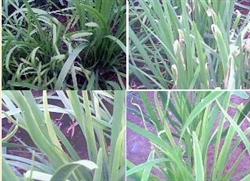 Why do garlic chives have withered leaves? How to prevent and control it? Please explain the causes and control methods
During the growing period, garlic chives often develop dry, withered leaves, mainly caused by Phytophthora blight and gray mold, and in some cases by physiological disorders. The following methods can be used for prevention and control:
Withered leaves caused by Phytophthora blight
Phytophthora blight is the main disease of garlic chives in protected cultivation. Water-soaked lesions appear on all affected parts; the lesions on leaves and flower stalks are dark green, while those on roots and bulbs are light brown, and none of the lesions have obvious margins. When humid, the lesions produce sparse white mold; when dry, the diseased leaves turn withered yellow. The roots and stems of infected plants become soft-rotted and cannot normally absorb water and nutrients, causing the aboveground parts to collapse or dry up. The occurrence of Phytophthora blight is related to drainage, so prevention and control should focus on drainage to reduce humidity and on crop rotation. In the early stage of the disease, use 25% metalaxyl at 600 times dilution, or 58% metalaxyl-mancozeb at 500 times dilution, or 40% fosetyl-aluminum at 200-300 times dilution, applying 40-50 kg of spray solution per mu, once every 7-10 days.
Withered leaves caused by gray mold
When the disease occurs, it first develops from the leaf tips downward; in the early stage, white or light brown spots form on both the upper and lower surfaces of the leaves. As the disease progresses, the lesions expand into spindle or oval shapes, and finally the lesion edges join together and the diseased leaves dry up. When humid, a gray to grayish-green and dense mold layer forms on the diseased leaves. In addition to drainage to reduce humidity, control can use 50% procymidone at 1000-1500 times dilution, sprayed once every 20 days, or 20% triadimefon at 800-1000 times dilution or 50% carbendazim at 600 times dilution, sprayed twice after harvesting the garlic chives and when the seedlings are 5-8 cm tall.
Root maggots are a pest that has occurred recently, mainly the onion fly and the late-eye fungus gnat. The root maggots bore into the bulbs to feed; a single clump often contains a dozen or several dozen larvae, and the damaged bulbs are hollowed out, causing rot, yellowing leaves, and death. For control, roots can be exposed to the sun, wood ash can be applied, or 2 kg of 5% phoxim granules per mu can be mixed with fine soil and scattered near the garlic chive roots, then covered with soil.
During the larval damage period, if the leaf tips are found to begin turning yellow and softening and toppling toward the ground, chemical drenching can be used for control: 75% phoxim emulsifiable concentrate at 500 times dilution or 25% quinalphos emulsifiable concentrate at 1000 times dilution, opening the surface soil around the root zone and spraying or drenching the roots, then covering with soil at once; spraying at 9-10 a.m. gives the best effect. During the adult emergence period (mid-to-late April, mid-June, mid-to-late July, mid-October), spray 10% imidacloprid (also known as Yibianjing, Kangfuduo, imidacloprid, Dagongchen, etc.) at 2000-2500 times dilution, or 75% phoxim
at 1000 times dilution or 2.5% deltamethrin at 3000 times dilution; spraying at 9-10 a.m. gives a good effect. Adults of the late-eye fungus gnat like to rest in shaded, humid places with much decaying matter. In summer and autumn, thinning leaves and improving ventilation can reduce its occurrence. It is attracted to light, so frequency-vibration insect-killing lamps can also be used to trap and kill it.
Withered leaves caused by physiological disorders
When garlic chives develop dry tips, withered leaves, and dead plants, it is sometimes also related to soil acidification, ammonia toxicity, high temperature (above 35°C), and low temperature causing white tips and rotten leaves; calcium deficiency, boron deficiency, and manganese excess can also cause yellowing of leaf tips, so targeted control measures can be taken.
Click to get more garlic chive cultivation techniques
Click to get more vegetable cultivation techniques