What are the control methods for rice seedling blight?
What harm does rice seedling blight cause? How do you control rice seedling blight? Experienced gardeners are also invited to help explain. For the harm and control methods of rice seedling blight, you can refer to the following introduction. Harm of rice seedling blight 1. Harm of seedling blight to rice sprouts: it occurs before emergence or just as the seedlings emerge; the young sprouts or young roots of the seedlings turn brown, and the diseased sprouts become distorted, rot, and die. Mold layers form on the seeds or at the base of the sprouts.
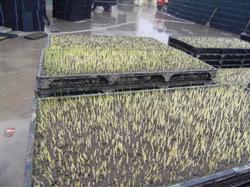 What harm does rice seedling blight cause? How do you control rice seedling blight? Experienced gardeners are also invited to help explain.
For the harm and control methods of rice seedling blight, you can refer to the following introduction.
Harm of rice seedling blight
1. Harm of seedling blight to rice sprouts: it occurs before emergence or just as the seedlings emerge; the young sprouts or young roots of the seedlings turn brown, and the diseased sprouts become distorted, rot, and die. Mold layers form on the seeds or at the base of the sprouts.
2. Harm of seedling blight to rice seedlings: from the needle stage to the 2-leaf stage of the seedlings, the heart leaves of the diseased seedlings turn yellow and withered, the leaves do not unfold, the base turns brown, and sometimes brown spots form on the leaf sheaths; the diseased roots also gradually turn yellowish brown. Mold layers form at the junction between the seeds and the base of the seedlings, the stem base is weak and breaks easily, and seedlings in the seedling bed often occur and die in clusters and patches.
Control methods for rice seedling blight:
Control method 1. Soil treatment:
For neutral and alkaline soil, acid adjustment treatment should be carried out before sowing, adjusting the pH value to below 6, which can effectively control infection and damage by seedling blight.
The specific method is: test the soil before sowing. For a pH value of 6-6.5, apply 30-40 g of special acid-adjusting fertilizer per sq m; for a pH value of 6.5-7, apply 40-50 g. Apply it one day before sowing and mix it thoroughly with the soil, adjusting the soil pH value to between 4.5-5.5.
Control method 2. Disinfect the seedling bed:
For a seedling bed that has undergone acid adjustment treatment, use 2 g of 70% dexon per sq m, dilute it into a 600-fold aqueous solution, and spray it evenly on the seedling bed. If the weather is sunny, halve the amount of dexon, otherwise it will burn the seeds.
Control method 3. Sowing density control:
Mastering the sowing rate is a key part of cultivating strong seedlings for dry-raised rice seedlings. Generally, for raising large seedlings of 50-55 days, the sowing rate is 20-25 g per sq m. If sowing is too dense, the seedlings become thin and spindly, their resistance weakens, and they are susceptible to seedling blight, while strong seedlings have stronger resistance and are less likely to be infected by seedling blight.
Control method 4. Early pesticide control:
From the 1-leaf 1-heart stage to the 2-leaf 1-heart stage, seedling blight infection and seedling death are most likely to occur. A 600-fold solution of dexon or a 500-fold solution of Likuling can be used for foliar spraying, then sprayed again after 5-7 days, for 2 consecutive sprays. Dexon in particular has a special effect on controlling seedling blight.
Control method 5. Seedling temperature control:
From sowing to emergence of early rice, focus on heat preservation, keeping the temperature inside the film at 30-32°C; at the 1-leaf 1-heart stage, focus on temperature and humidity control, keeping the temperature inside the film at 25°C; at the 2-leaf 1-heart stage, half-open the film from 10 a.m. to 4 p.m. on sunny days, open the film for 1-2 hours at noon on cloudy days, and open the film for ventilation on rainy days, but the temperature inside the film must not be lower than 12°C, otherwise seedling blight is easily induced; at the 3-leaf 1-heart stage, remove the film.
Click to get more rice cultivation techniques
Click to get more grain crop cultivation techniques