How to prevent and control rice sheath blight? A detailed guide to the control methods
How serious is the damage caused by rice sheath blight? How do you prevent and control rice sheath blight? We ask netizens to help explain. The damage caused by rice sheath blight is divided into leaf sheath infection, leaf infection and stem infection, described in detail below. Leaf sheath infection: near the water surface, small dark green water-soaked spots with blurred edges appear, which then gradually expand into an oval or...
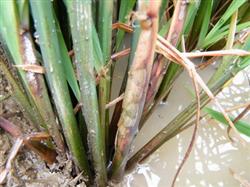 How serious is the damage caused by rice sheath blight? How do you prevent and control rice sheath blight? We ask netizens to help explain
The damage caused by rice sheath blight is divided into leaf sheath infection, leaf infection and stem infection, described in detail below.
Leaf sheath infection:Near the water surface, small dark green water-soaked spots with blurred edges appear, which then gradually expand into an oval or cloud-patterned shape; the center is grayish green or grayish brown, and when humidity is low the center is pale yellow or grayish white; the central tissue breaks down and becomes semi-transparent, with dark brown edges. In severe cases, several lesions merge to form large lesions, appearing as irregular cloud-patterned spots, often causing the leaves to turn yellow and die.
Leaf symptoms:The lesions are cloud-patterned with yellowing edges; when the disease develops quickly, the lesions are dirty green and the leaves rot very quickly.
Stem damage:At first it is dirty green, then turns grayish brown; the plant often cannot head, and if it does head, there are many empty grains. In high humidity, white net-like mycelium grows on the diseased part, then gathers into white mycelial masses and forms sclerotia; the sclerotia are dark brown and easily fall off. Under high temperature, a layer of white powdery mold forms on the lesions.
Main factors for rice sheath blight:High temperature and high humidity are the main factors for the disease. It can occur at temperatures of 18-34°C, with 22-28°C being the most suitable. The relative humidity for disease development is 70-96%, with over 90% being the most suitable. Long-term deep irrigation, one-sided and late application of nitrogen fertilizer, and a dense, overcrowded rice canopy with excessive vegetative growth promote the occurrence and spread of sheath blight.
Control methods for rice sheath blight:
Method one:Strengthen cultivation management, apply sufficient base fertilizer, apply topdressing early, do not apply nitrogen fertilizer one-sidedly, and increase the application of phosphorus and potassium fertilizers.
Adopt a formula fertilization technique so that the rice does not droop its leaves in the early stage, does not grow excessively in the middle stage, and does not stay green late in the season.
For irrigation, achieve shallow water for tillering and expose the field when there are enough tillers.
Sun the field to promote rooting; for fertile fields, sun more heavily, for poor fields, sun lightly; keep the field moist during heading; do not cut off water early, prevent premature aging, and master the principle of "shallow at the front, sun in the middle, moist at the back."
Method two: Use chemical spraying for control:
1. 2.5% jinggangmycin 100 ml. Usage: dilute with 50 kg of water and spray, or dilute with 400 kg of water and splash-apply.
2. 20% triadimefon emulsifiable concentrate 50-76 ml;
3. 50% thiophanate-methyl wettable powder 100 g;
4. 50% carbendazim wettable powder 100 g;
5. 30% wenkulili wettable powder 50-75 g;
6. 50% methyl tolclofos (Rizolex) wettable powder 200 g. Dosage: 50 kg of spray liquid per 667 sq m.
Click to get more rice cultivation techniques
Click to get more grain crop cultivation techniques