What is lettuce gray mold? A detailed guide to lettuce cultivation techniques
What is lettuce gray mold? What harm does lettuce gray mold cause? How do you prevent and control lettuce gray mold? Please provide guidance. Lettuce gray mold is a common and highly destructive major disease of lettuce. In addition to harming lettuce, the disease can also harm more than 20 kinds of vegetables and other crops, including tomato, eggplant, pepper, cucumber and watermelon...
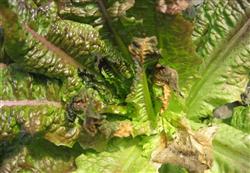 What is lettuce gray mold? What harm does lettuce gray mold cause? How do you prevent and control lettuce gray mold? Please provide guidance
Lettuce gray mold is a common and highly destructive major disease of lettuce. In addition to harming lettuce, the disease can also harm more than 20 kinds of vegetables and other crops, including tomato, eggplant, pepper, cucumber and watermelon. In years with low temperatures and frequent continuous rainy weather, the damage is severe, often causing lettuce leaves to yellow and die, stems to rot, and in severe cases the entire plant to die, seriously affecting lettuce yield.
The harm caused by lettuce gray mold:
Lettuce gray mold mainly harms leaves and stems. There are two main types of leaf lesions: one starts from the leaf tip or leaf margin, forming brown, wet-rot, irregular lesions, sometimes V-shaped or semicircular; the other type of lesion starts inside the leaf and is nearly round.
Gray mold lesions are generally relatively large, with obvious concentric rings, and the lesions tend to rupture when humidity is low. Lesions on the stem initially appear light brown and water-soaked, and later expand to form brown rot; leaves connected to the stem start from the petiole and spread along the petiole, forming dark brown spots, and finally the whole plant gradually dries up and dies. When moist, a gray mold layer (conidiophores and conidia) forms on the surface of the diseased parts.
Control methods for lettuce gray mold:
1. Ecological control methods: In greenhouses and glasshouses, measures such as lowering daytime temperature, raising nighttime temperature and increasing daytime ventilation time are used to reduce humidity inside the structure and the time during which condensation forms, so as to control the disease. In open-field cultivation, drainage should be carried out promptly after rain to reduce humidity.
2. Agricultural control methods: Reasonably control the amount of watering; do not water too much at one time, to prevent excessive humidity. Remove diseased leaves promptly and take them outside the structure to be burned in a centralized manner or buried deeply.
3. Chemical control methods: Once scattered diseased leaves are found, immediately begin spraying 50% procymidone wettable powder at 1000 times dilution, or 40% dimethachlon wettable powder at 800 times dilution, or 50% carbendazim and diethofencarb wettable powder at 800 times dilution, or 50% iprodione wettable powder at 1000 times dilution, or 25% fenpyrazamine emulsifiable concentrate at 1000 times dilution.
Spray once every 7-10 days, for 3-4 consecutive sprays. In greenhouses, 0.3-0.5 kg of 20% thiabendazole smoke agent can also be used per 667 sq m (1 mu) for fumigation, giving an even better control effect.
Click to get more lettuce cultivation techniques
Click to get more vegetable cultivation techniques