How should loofah vine decline and crop fatigue after harvest be prevented and treated?
How should loofah vine decline and crop fatigue after harvest be prevented and treated in summer? Please provide guidance methods. The environment of excessively long daylight hours in summer goes against the growth habits of loofah, and this is the main reason for few female flowers and difficult fruit setting in summer loofah. Loofah is a short-day plant, and the current excessively long daylight hours inhibit the flowering conditions of loofah, causing flower...
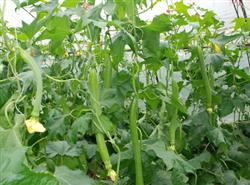 How should loofah vine decline and crop fatigue after harvest be prevented and treated in summer? Please provide guidance methods.
The environment of excessively long daylight hours in summer goes against the growth habits of loofah, and this is the main reason for few female flowers and difficult fruit setting in summer loofah. Loofah is a short-day plant, and the current excessively long daylight hours inhibit the flowering conditions of loofah, causing poor flower bud differentiation and a reduction in female flowers. Therefore, in summer loofah management, attention should be paid to shortening the daylight hours. A shade net or straw mat can be covered over the greenhouse, with the covering time preferably before 8:00 in the morning.
At the same time, although loofah likes warmth and tolerates heat, the current excessively high greenhouse temperature, often above 40°C during the day and above 25°C at night, is not conducive to loofah growth. In particular, excessively high night temperatures greatly increase respiration consumption, making loofah plants prone to excessive vegetative growth and thin, weak stems, which in turn easily leads to difficult fruit setting. Therefore, in summer loofah management, temperature control must be strengthened so that it both meets the growth needs of loofah and does not cause excessively high night temperatures. Measures such as ventilation cooling, shade cooling and water spraying cooling can be used to control the daytime temperature, keeping it at 30°C~35°C, and the night temperature is best reduced to around 20°C to avoid excessive nutrient consumption.
In addition, untimely vine dropping or too small a vine-dropping range can also easily lead to excessive vegetative growth of loofah and difficulty in fruit setting. Therefore, summer loofah requires strengthened vine-dropping management. For loofah in the middle and late stages of the spring crop, vines should be dropped in a timely manner along with fruit picking and pinching; for overwintering loofah in the early growth stage, while dropping vines in a timely manner, the vine-dropping range should be increased, with each vine dropping no less than 80 cm, and it is sufficient to keep the plant height at around 120 cm.
To promote fruit setting in loofah, hormone regulation can also be combined. For overwintering loofah, plant growth regulators (such as ethephon, etc.) can be sprayed early to promote female flower differentiation and increase the flowering rate. For excessively vigorous plants, 5% chlormequat 2000-times solution or 25% mepiquat chloride 750-times solution can be sprayed for control, and so on.
Click to get more loofah cultivation techniques
Click to get more vegetable cultivation techniques