Detailed explanation of Pinellia ternata cultivation techniques: this is how to achieve high yields
In previous years, the yield of Pinellia ternata has always been low. How can Pinellia ternata be grown to achieve high yields? We also ask experienced friends to help introduce cultivation methods. To obtain good yields when growing Pinellia ternata, you can refer to the following methods: Method 1. Choose high-quality soil for planting: The Pinellia ternata tubers growing in the soil have relatively...
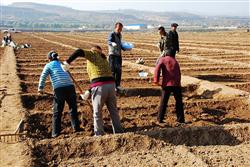 In previous years, the yield of Pinellia ternata has always been low. How can Pinellia ternata be grown to achieve high yields? We also ask experienced friends to help introduce cultivation methods.
To obtain good yields when growing Pinellia ternata, you can refer to the following methods for planting:
Method 1. Choose high-quality soil for planting:
The Pinellia ternata tubers growing in the soil have relatively strict requirements for the soil. They are afraid of both acidity and alkalinity, afraid of both sand and clay, require fertile soil, and yet restrict the use of chemical fertilizers. In the early stage they prefer moist soil, and in the later stage they prefer dry soil.
Because the growth of Pinellia ternata has these four contradictory soil characteristics, the plot for planting Pinellia ternata should be selected as moist and fertile sandy soil with relatively strong water and fertilizer retention, loose texture, good drainage and irrigation, and a neutral reaction. Semi-shaded, semi-sunny gentle slope mountain land and woodlands or orchards with certain light conditions can also be chosen for planting.
The soil must meet the following: pH value between 6.5 and 7.5, neither sandy nor clayey, and organic matter content greater than 1.2.
Method 2. Selection of planting terrain:
The choice of terrain is often the issue most easily overlooked by Pinellia ternata growers, who generally consider it unimportant; in fact, for Pinellia ternata cultivation, the reasonable selection of terrain is directly related to the high quality and high yield of Pinellia ternata.
The terrain of the Pinellia ternata planting site should meet the following: in low mountains and hilly land, a semi-shaded, semi-sunny gentle hillside should be selected, with a slope of 10 degrees to 30 degrees being best; when planting Pinellia ternata in plain areas, choose a plot that can be irrigated and drained and has high terrain, and drainage ditches must be prepared before planting.
In addition, an on-site survey of the surrounding environment should also be conducted: there should be no pollution sources within 1000 m, and it should be more than 100 m away from main traffic roads. The irrigation water used should meet the national farmland irrigation water standards. Correct and reasonable selection of terrain is the foundation for high yield of Pinellia ternata, and must not be treated carelessly.
Method 3. Select excellent Pinellia ternata varieties:
Because artificial cultivation of Pinellia ternata began in the mid-1980s, the time has been relatively short, and coupled with the characteristics of Pinellia ternata, prices and other factors, as of now there is still no improved variety that has formally passed national approval.
Research and observation show that, based only on leaf type, Pinellia ternata can be divided into several types: bamboo-leaf type, bamboo-like-leaf type, willow-leaf type (the author calls it "narrow three-leaf"), apricot-leaf type, palm-leaf type, and so on. The bamboo-leaf type and apricot-leaf type are relatively widely distributed and have been found in the main production areas of Pinellia ternata nationwide; the bamboo-like-leaf type and palm-leaf type are distributed in parts of Guizhou, Yunnan, Sichuan, Hunan, Jiangxi and other provinces and in the Yangtze River basin; "narrow three-leaf" Pinellia ternata is mainly native to Shandong.
Comparing and screening among the different leaf types of Pinellia ternata above, the "narrow three-leaf" Pinellia ternata native to Heze, Shandong and Fengxian, Jiangsu has the highest yield and relatively good quality. It grows vigorously, has many stem and leaf tillers, large and thick leaves, relatively strong photosynthesis and resistance, early and numerous bulbils, and large and round commercial individuals. It is currently an excellent variety for artificial cultivation of Pinellia ternata.
Method 4. Selection of seed-soaking agents:
For pests and diseases in artificially cultivated Pinellia ternata, prevention is primary and treatment is secondary. Once large-area pests and diseases occur during the growth period, treatment is quite troublesome. It not only affects the growth of Pinellia ternata, but also easily produces pesticide residues and increases cultivation costs. Therefore, treating the seed stems before sowing is very important.
However, in the selection, dosage and method of agents for soaking and mixing seed stems, it is necessary to correctly choose efficient, low-toxicity, low-residue fungicides and seed-dressing agents; the dosage and treatment method must be scientific and reasonable, just right, and must not be used indiscriminately or excessively, so as to avoid counterproductive effects and unnecessary losses.
Method 5. Selection of planting time:
Pinellia ternata can grow in most provinces and regions of China. In order to maximize the growth time of Pinellia ternata and improve yield and quality, the best sowing time should be selected according to different regions.
Southern provinces and regions without frost or with a relatively short frost period can cultivate in late autumn or winter; the most suitable planting time in the Huang-Huai region is late February to early March (Yushui to Jingzhe); the planting time in some areas of the northwest and northeast can be appropriately postponed.
In short, the most suitable planting time for Pinellia ternata in each province and region is, based on local actual measurement, when the underground temperature at 5 cm stabilizes at 5°C to 7°C, which is the best sowing time. Sowing as early as possible and taking effective measures can cause the leaf stalks of Pinellia ternata to grow horizontally in the soil and produce bulbils. The bulbils formed in the soil are large and can quickly take root and sprout, forming a new plant. This increases the propagation coefficient and is one of the important technical measures for high-yield cultivation of Pinellia ternata.
Method 6. Planting method for Pinellia ternata:
On the prepared sowing bed surface that has been finely leveled and raked, open horizontal furrows for drilling. Sow the graded large and small seed stems separately. For grade-one seed stems, the row spacing and plant spacing are relatively wide (30 cm), and sowing is relatively deep (7-9 cm); and so on. For grade-four seed stems, the row spacing and plant spacing are relatively dense (15 cm), and planting is relatively shallow (3-4 cm).
After sowing, apply a layer of mixed fertilizer soil on top, made by evenly mixing decomposed compost and barnyard manure with human and livestock manure, grass-soil ash, and so on. Finally, cover with soil slightly lower than the ground surface (semi-mechanized sowing can also be used, completing it in one pass, which can increase efficiency by 80%).
Because there are many weeds during the growth period of Pinellia ternata, especially at the seedling stage, often only grass can be seen and no Pinellia ternata, so after sowing of Pinellia ternata is completed, immediately spray a special herbicide for Pinellia ternata, and immediately cover with plastic film, which can effectively prevent and control weed damage. In particular, the control effect on gramineous weeds reaches 100%. After spraying the herbicide, immediately cover with plastic film. The plastic film used can be ordinary agricultural plastic film (0.014 mm thick), or high-density plastic film (0.008 mm) can also be used. The width of the plastic film is selected according to the width of the bed.
Click to get more Pinellia ternata cultivation techniques
Click to get more medicinal herb cultivation techniques