How to manage Pinellia ternata in winter? Key points of Pinellia ternata cultivation techniques
How to manage Pinellia ternata in winter? Is there any experienced netizen who can give guidance? Winter is approaching. If the overwintering management of Pinellia ternata is poor, it will directly affect its yield and quality. Therefore, strengthening its winter management is very important. The following methods for winter management of Pinellia ternata are listed by Zhongdiwang for everyone's...
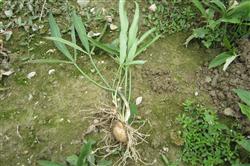 How to manage Pinellia ternata in winter? Is there any experienced netizen who can give guidance?
Winter is approaching. If the overwintering management of Pinellia ternata is poor, it will directly affect its yield and quality. Therefore, strengthening its winter management is very important. The following methods for winter management of Pinellia ternata are listed by Zhongdiwang for everyone's reference.
Winter management methods for Pinellia ternata:
Method 1: Inspect the seed tubers of Pinellia ternata:
Usually, the tubers of Pinellia ternata begin to take root and emerge about half a month after planting. Sometimes, due to low temperatures, seed rot may occur, so the growth of the seed tubers should be checked in time.
For places where seedlings have not emerged for a long time, the soil can be gently scraped away by hand or with a bamboo piece, wooden stick, etc. Any seed tubers that have not rooted or whose rootlets are yellow-black are inferior seeds and should be dug out and replanted in time.
Method 2: Prevention of waterlogging and drought resistance in the cultivation site:
If continuous rainy weather occurs in winter, the soil is prone to waterlogging and lack of oxygen, which is not only unfavorable for the tubers of Pinellia ternata to take root underground, but also causes disease and rot.
Therefore, at this time, attention should be paid to clearing ditches and draining water, so that the water dries up after the rain stops.
If drought occurs in winter, it will cause the tubers to dry up and shrink, affecting underground growth. Furrow irrigation can be used, allowing water to seep through the furrows to moisten the soil, and after irrigation, the water in the furrows should be drained in time.
Method 3: Removal of field weeds:
During December in winter, advantage should be taken of sunny days to carry out intertillage and loosen the soil, and to remove perennial weeds in time. Weeding should mainly be done by digging out weeds or pulling them by hand to prevent damage to the tubers.
For plots with severe weeds, choose a sunny day and spray 800-1000 g of 10% glyphosate mixed with 60 kg of water per mu for control; alternatively, 150-250 ml of 20% paraquat aqueous solution mixed with 50 kg of water per mu can be evenly sprayed for control.
Method 4: Application of farmyard manure:
Adding farmyard manure to the planting site can not only increase fertilizer efficiency and promote tuber growth, but also preserve heat and moisture.
Therefore, before the severe cold arrives, 2500-3000 kg of decomposed pig and cattle pen manure per mu, plus 50 kg of decomposed cake fertilizer or 75 kg of plant ash, should be evenly spread between the rows on the bed surface to ensure that the tubers overwinter safely.
Click to get more Pinellia ternata cultivation techniques
Click to get more medicinal herb cultivation techniques