Video Tutorial on Cultivation Techniques for Medicinal Honeysuckle
Honeysuckle (Japanese honeysuckle, Lonicera japonica) is a perennial evergreen climbing plant, and every part of it has multiple medicinal values. To cultivate medicinal honeysuckle, the following points should be done well: 1. Select good varieties: Medicinal honeysuckle requires thick, strong branches, a reasonable structure, multiple flowering cycles, abundant flowers, good quality and high yield. For example, Jizhuahua (Chicken Claw Flower) and Damaohua (Big Hairy Flower) are relatively good varieties for medicinal cultivation...
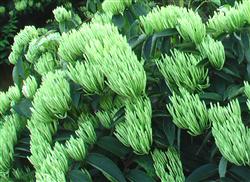 Honeysuckle (Japanese honeysuckle, Lonicera japonica) is a perennial evergreen climbing plant, and every part of it has multiple medicinal values. To cultivate medicinal honeysuckle, the following points should be done well:
1. Select good varieties:
Medicinal honeysuckle requires thick, strong branches, a reasonable structure, multiple flowering cycles, abundant flowers, good quality and high yield. For example, Jizhuahua (Chicken Claw Flower) and Damaohua (Big Hairy Flower) are relatively good varieties for medicinal cultivation.
2. Choose a site and build the garden:
For planting honeysuckle, choose a plot of open ground with loose soil, convenient drainage and irrigation, and rich in humus, sandy loam soil as the planting site. You can also use scattered plots in front of and behind the house, beside ditches, beside ponds, etc., carry out deep plowing and soil improvement, apply 50 dan of farmyard manure per mu, and form beds 1.2 m wide.
3. Cultivate strong seedlings:
Honeysuckle is mainly propagated by cuttings. Before budding in early spring, select cuttings with 1-4 buds, remove the lower leaves, and insert them into a prepared seedbed as they are cut. Shade them and water them; in dry seasons, spray water once each in the morning and evening, and water as appropriate during the day depending on the soil condition. After the cuttings take root and grow leaves, gradually remove the shade material, and water once every half month with 1-2% diluted organic fertilizer. As the seedlings grow, the fertilizer concentration should be increased. After half a year, they can be transplanted to the field.
4. Scientific management and fertilization:
Carry this out before the plants sprout in early spring or before the cold wave in early winter. Open a furrow or ring-shaped trench beside the plant, and apply 10 kg of decomposed organic fertilizer, 0.1 kg of ammonium sulfate, and 0.1 kg of superphosphate per plant. From May to June, apply decomposed dilute organic fertilizer water 2-3 times as a top dressing to accelerate seedling growth.
For mature plants, in order to increase the number of flower harvests and improve flower quality and yield, during the flower bud differentiation stage of each harvest, 0.5-1% potassium dihydrogen phosphate can also be sprayed on the leaves. The ideal plant shape for medicinal honeysuckle is a small umbrella-shaped shrub that is short, upright, and has many branching levels. This must be achieved through pruning.
The specific method is to cut off the upper half at a height of 30 cm on the main trunk to promote the buds below the cut to sprout into branches, retain 4-5 branches that are evenly distributed and fairly similar in thickness, and then cut off the upper half of branches at each level. Every spring before budding, a comprehensive garden cleanup should also be carried out, cutting off dead old branches, decayed and damaged branches, thin and weak branches, shade branches, and root suckers, and destroying them in a concentrated manner to reduce sources of disease and the base population of pests.
The main pests of honeysuckle are aphids and the coffee tiger longhorn beetle. The former damages leaves and flower buds and should be controlled promptly. The latter uses its larvae to bore into and feed on the xylem of the vine stems, causing hollow main trunks. The control method is manual hooking and killing during the larval stage, or using cotton balls soaked in dichlorvos solution to plug the holes and then sealing them with mud slurry. The main disease is honeysuckle brown spot disease, which generally occurs severely in summer and causes brown necrotic spots on leaves. At the early stage of the disease, spray with jinggangmycin.
5. Harvesting and processing:
The main medicinal part of honeysuckle is the flower. When harvesting, both the flowers and the weather should be observed so as to pick at the right time.
When the base of the flower shows green, the top is milky white, the flower is in bud and about to open, the color is bright, and it has a glossy sheen, this is the best sign for picking flowers. Choose a sunny day when the dew has not yet dried, pick gently and place gently, and do not press with your hands. To ensure the medicinal quality and properties of the flowers, the flowers picked that day should be dried promptly. On sunny days, spread the flowers evenly in a thin layer on a drying mat and let the sun dry them naturally.
On cloudy and rainy days, use heated drying. Build a square drying room indoors, place a heating device at the bottom, and set up layered drying racks in the room with 25 cm between each layer. Spread the flowers evenly on the drying tools with a spread thickness not exceeding 1 cm, then move them onto the layered racks.
In the initial stage, the drying temperature for honeysuckle is 30-35°C; after 2 hours, raise it to 40°C; keep it at 45-50°C for 5-10 hours; after about another 10 hours, most of the moisture in the fresh flowers has been released, and the drying temperature is raised to 55°C. When the dried flowers rustle when pinched, break apart when grasped, have a pure color, and a rich fragrance, they are ready. The drying process must be continuous, drying fully in one go, with no stopping midway or turning at will. Because the drying method has many advantages and can better ensure the medicinal value of the flowers, it is more often used. You can also dry them lightly in the sun first and then dry them fully with heat.
Click to get more honeysuckle cultivation techniques
Click to get more medicinal herb cultivation techniques