What are the control methods for onion downy mildew?
What harm does onion downy mildew cause? How to control it? We also ask experienced gardeners to share their advice. Zhongdiwang has compiled the harm and control methods of onion downy mildew, listed below for gardeners' reference. Harm of onion downy mildew: Onion downy mildew mainly affects leaves and flower stalks. On flower stalks, yellowish-white...
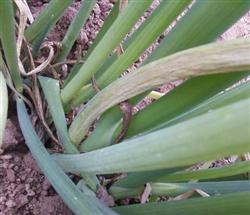 What harm does onion downy mildew cause? How to control it? We also ask experienced gardeners to share their advice.
Zhongdiwang has compiled the harm and control methods of onion downy mildew, listed below for gardeners' reference.
Harm of onion downy mildew:
Onion downy mildew mainly affects leaves and flower stalks. On flower stalks, relatively large yellowish-white or cream-yellow infection spots first appear, spindle-shaped or elliptical, producing white mold on them, which later turns pale yellow or dark purple. When the middle and lower leaves are infected, the part above the diseased area gradually dries up and droops. When the false stem is infected, it often splits and bends. When the bulb is infected, it can cause systemic infection; such diseased plants are stunted, with deformed or twisted leaves, and when humidity is high, a large amount of white mold grows on the surface.
When onion leaves are mildly affected, the lesions appear pale green and long elliptical; in severe cases they spread to the upper half of the leaf, the plant turns yellow or dies, and the diseased leaves form an inverted "V" shape. When flower stalks are infected, the symptoms are the same as on the leaves, and they are prone to breaking off and dying at the diseased area. When humidity is high, a white to purple-gray mold layer grows on the diseased area, which is the pathogen's sporangiophores and sporangia. After the bulb is infected, it becomes soft, the outer scales become rough or wrinkled on the surface, the plant is stunted, and the leaves are twisted and deformed.
Generally, low-lying areas with poor drainage and continuous cropping fields have severe disease incidence, and it is prone to epidemics in cool, rainy weather or weather with frequent heavy fog.
Control methods for onion downy mildew:
1. Choose plots with high terrain and easy drainage for planting, and carry out a 2-3 year rotation with crops other than Allium species.
2. Choose disease-resistant varieties. Generally, red-skinned and yellow-skinned varieties are more resistant, such as Yefu No. 1, etc.
3. Treat seeds with 35% Ridomil at 0.3% of seed weight, or soak seeds in warm water at 50°C for 25 minutes, then soak in cold water, remove, air-dry, and sow.
4. At harvest, clean up diseased and residual plants, carry them out of the field and bury them deeply or burn them.
5. In the early stage of disease, spray 90% fosetyl-aluminum wettable powder at 400-500 times dilution, or 75% chlorothalonil wettable powder at 600 times dilution, 50% metalaxyl-copper wettable powder at 800-1000 times dilution, 64% oxadixyl-mancozeb wettable powder at 500 times dilution, 72.2% propamocarb aqueous solution at 800 times dilution, 70% thiophanate-methyl-mancozeb wettable powder at 500 times dilution, S0% copper hydroxide-fosetyl-aluminum wettable powder at 500 times dilution, once every 7-10 days, for 2-3 consecutive treatments.
Click to get more onion cultivation techniques
Click to get more vegetable cultivation techniques