How to prevent and control barley stripe disease? A must-read for barley growers
How to prevent and control barley stripe disease? What are the harms of barley stripe disease? Please, readers, let me explain the harms of barley stripe disease: this disease mainly damages leaves and leaf sheaths. The disease can appear at the seedling stage, with initially light yellow spots or short stripes, and it is most severe from the jointing to heading stage. The typical symptom is...
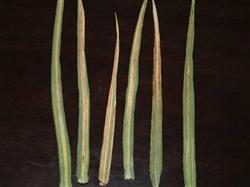 How to prevent and control barley stripe disease?What are the harms of barley stripe disease?Please, readers, let me explain
Harms of barley stripe disease:
This disease mainly damages leaves and leaf sheaths. The disease can appear at the seedling stage, with initially light yellow spots or short stripes, and it is most severe from the jointing to heading stage. The typical symptom is the formation of slender stripes from the leaf base to the leaf tip, parallel to the leaf veins, either continuous or interrupted. The color of the diseased spots changes from yellow to brown, and then the tissue dies.
The area around the diseased spots also becomes chlorotic and yellow, making the diseased field appear yellowish-brown. Diseased plants die early or are stunted, fail to head or become bent and deformed, and either set no seed or produce shriveled grain. This seriously affects the yield and quality of malting barley.
When humidity is high, a black mold layer grows on the diseased leaves and can release large numbers of conidia. If this coincides with barley flowering, it infects the floral organs and causes the seeds to carry the pathogen.
Barley stripe disease is a fungal disease. The pathogen lurks in barley seeds and becomes the source of inoculum for the disease the following year. This disease also has another characteristic: it only infects seedlings at the barley emergence stage, then continues to spread within the plant, causing successively emerging leaves to develop the disease.
Barleystripe disease control methods:
Method 1: Soak seeds in 1% lime water for 48 hours, then dry and sow;
Method 2: Take 15 ml of 10% dithiocyanomethane (seed-soaking agent), add 1.5-2.0 kg of water to make a medicinal solution, then evenly spray it onto 50 kg of barley seed while stirring, cover and let the seed sit for 8 hours, then dry and sow;
Method 3: Treat 100 kg of barley seed with 100 g of 2% tebuconazole (Raxil) seed dressing;
Method 4: Treat 100 kg of barley seed with 330 ml of 3% difenoconazole suspension seed coating agent, 200 g of 10% difenoconazole, or 150 g of 25% triadimenol, or use JINLISI (propiconazole) emulsifiable concentrate, HEGUOLI (diniconazole) emulsifiable concentrate, SHIBAOKE (prochloraz), triadimenol, etc. for seed dressing, and good disease control results have been obtained.
In addition, planting disease-resistant varieties, establishing disease-free seed multiplication fields, and promoting rapid seedling emergence to shorten the susceptible period, such as sunning the seed for 1-2 days before sowing, sowing early at the appropriate time before winter, sowing late at the appropriate time in spring, as well as fine land preparation and appropriately shallow sowing, can all reduce the disease.
Click to get more barley cultivation techniques
Click to get more grain crop cultivation techniques