How to Grow Cassava for High Yield? A Detailed Guide to Cultivation Methods
How to grow cassava for high yield? Here are the methods. To achieve high yield when growing cassava, you can refer to the following cultivation methods: 1. Apply plenty of base fertilizer. Many people plant cassava on hillsides and dry land without applying base fertilizer and just let it grow wherever it lands, so the yield is very low. To improve the economic returns of cassava cultivation, you should first plow the soil well, with a plant spacing of 1 m, and dig...
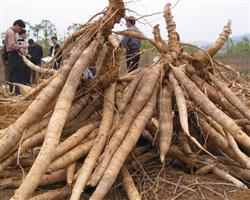 How to grow cassava for high yield? Here are the methods
To achieve high yield when growing cassava, you can refer to the following cultivation methods:
1. Apply plenty of base fertilizer
Many people plant cassava on hillsides and dry land without applying base fertilizer and just let it grow wherever it lands, so the yield is very low. To improve the economic returns of cassava cultivation, you should first plow the soil well, with a plant spacing of 1 m, dig the planting holes, and apply plenty of mixed fertilizer such as chicken manure, plant ash and garbage sludge, one large bowl per hole, to lay a good foundation for seedling emergence and tuber growth.
2. Select good-quality varieties
Good seed produces good seedlings; for high or low yield, a good variety is the key. Good cassava varieties include Nanzhi 188, Zhongshan cassava and others. If tail stems or branch stems are used as seed, the tubers will be few and small. You should use disease-free, undamaged, close-noded main root stems of 1 m as seed. Take 20 cm as a section, use a sharp knife to cut a slanted opening at the lower end, and 8 cm above the slanted opening, cut through the bark to the xylem, peel out a notch 2 cm long and 3/4 of the stem circumference, leaving 1/4 of the bark to transport water and nutrients; at 14 cm up, cut another notch in the same way, place the seed stem horizontally in the base-fertilizer hole, and cover with 3-5 cm of soil. This new planting method is drought-tolerant, wind-resistant, not easily uprooted or lodged, and produces tubers in multiple layers, making it easy for the tubers to grow thicker and longer forward.
3. Control insects and prevent rats
When cassava has just emerged, cutworms like to eat the seedlings. One cutworm can eat one seedling in a night, causing great damage. Cutworms dig burrows, come out at night to eat cassava seedlings, and burrow back before dawn, sealing the burrow entrance with fresh soil. Therefore, digging 10-20 cm by hand can catch them, and they can be used to feed chickens. In the tuber-growing stage, rats will steal and eat the tubers, so rat control measures must be taken.
4. Weed and fertilize
When the seedlings grow to about 20 cm, keep only the thickest and strongest main shoot, and all other branch shoots can be picked off to feed fish. At the same time, weed and loosen the soil, pull up the weeds and shake off the soil to cover around the roots, apply one spoonful of urea per plant, and cover with soil to promote seedling growth. When the seedlings grow to 1 m, carry out a second weeding and soil loosening, but do not hoe through the tuber strips; apply one spoonful of compound fertilizer per plant, which promotes both shoot and tuber growth. In the tuber-growing stage, generally in dry seasons, because the soil is hard, the tubers grow with difficulty, which will inevitably reduce yield, so at this time it is best to water once a week to keep the soil moist and loose, which is good for tuber growth.
5. Keep good seed stems
If cassava is harvested too early, it will have less starch, more water and a low drying rate. You should harvest the tubers after mid-November on a clear day. Take 1 m of the thick, strong, disease-free, close-noded main stem, or the main stem below the fork, dig a hole in a north-facing and south-facing mountain bank, store it in the hole, and seal the entrance well. You can also dig a deep pit on sloping land, put the stems in, cover with 10 cm of soil, and then cover with rice straw to avoid damage from frost and snow, making full preparations for spring planting next year.
Click to get more cassava cultivation techniques
Click to get more grain crop cultivation techniques