Control Methods for the Twenty-Eight-Spotted Ladybird Beetle on Leaf Goji
What harm does the twenty-eight-spotted ladybird beetle do to leaf goji? How do you control the twenty-eight-spotted ladybird beetle on leaf goji? Netizens are asked to help introduce methods. Zhongdiwang has compiled the harm caused by the twenty-eight-spotted ladybird beetle to leaf goji and its control methods, listed below for netizens' reference. Harm caused by the twenty-eight-spotted ladybird beetle: twenty...
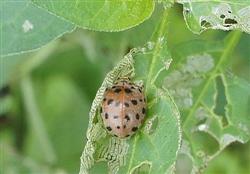 What harm does the twenty-eight-spotted ladybird beetle do to leaf goji? How do you control the twenty-eight-spotted ladybird beetle on leaf goji? Netizens are asked to help introduce methods
Zhongdiwang has compiled the harm caused by the twenty-eight-spotted ladybird beetle to leaf goji and its control methods, listed below for netizens' reference.
Harm caused by the twenty-eight-spotted ladybird beetle:
The twenty-eight-spotted ladybird beetle mainly damages Solanaceae vegetables such as goji, eggplant and chili, and can also damage Cucurbitaceae plants such as loofah. Generally, the adults feed on the leaves, eating the leaf mesophyll and leaving the epidermis, so that many irregular, nearly parallel, semi-transparent sunken fine lines appear on the surface, and they also bite the leaves into holes or notches.
The twenty-eight-spotted ladybird beetle overwinters as adults in weeds, old bark, fences and wall crevices. In March and April of the following year, the overwintering adults begin to be active, first damaging wild Solanaceae plants (such as black nightshade, etc.), and later successively moving to goji and eggplant to cause damage. The adults lay eggs on the underside of leaves, the eggs stand upright, and ten to several dozen are clustered into a mass. The adults have a habit of feigning death.
Control methods for the twenty-eight-spotted ladybird beetle:
Method 1: Manually remove egg masses and capture and kill adults and nymphs.
Method 2: Spray pesticide to kill adults and nymphs. Grasp the peak emergence period of adults and the initial hatching period of nymphs, and spray 80% dichlorvos, or 50% phoxim, or 25% quinalphos at 1000 times dilution, or 21% miehshabi emulsifiable concentrate at 6000 times dilution, or 25% deltamethrin emulsifiable concentrate, or 20% fenvalerate emulsifiable concentrate at 2500-3000 times dilution, or 10% imidacloprid wettable powder at 5000 times dilution, or 44% duochongqing emulsifiable concentrate at 1500 times dilution. Spray 1-2 times each during the adult and nymph stages, once every 7-10 days, applying them alternately, spraying evenly and thoroughly.
Click to get more goji cultivation techniques
Click to get more medicinal herb cultivation techniques